
Thinking tool
What if your own side is in the wrong?
If you want a rule to apply to someone else, would you accept it for yourself? Three questions worth asking about a policy you support.

In this essay
You support a policy. Someone who would have to live with it objects. How would you know if they had a point? If your answer is “I’m trying to do the right thing,” the other person can say exactly the same.
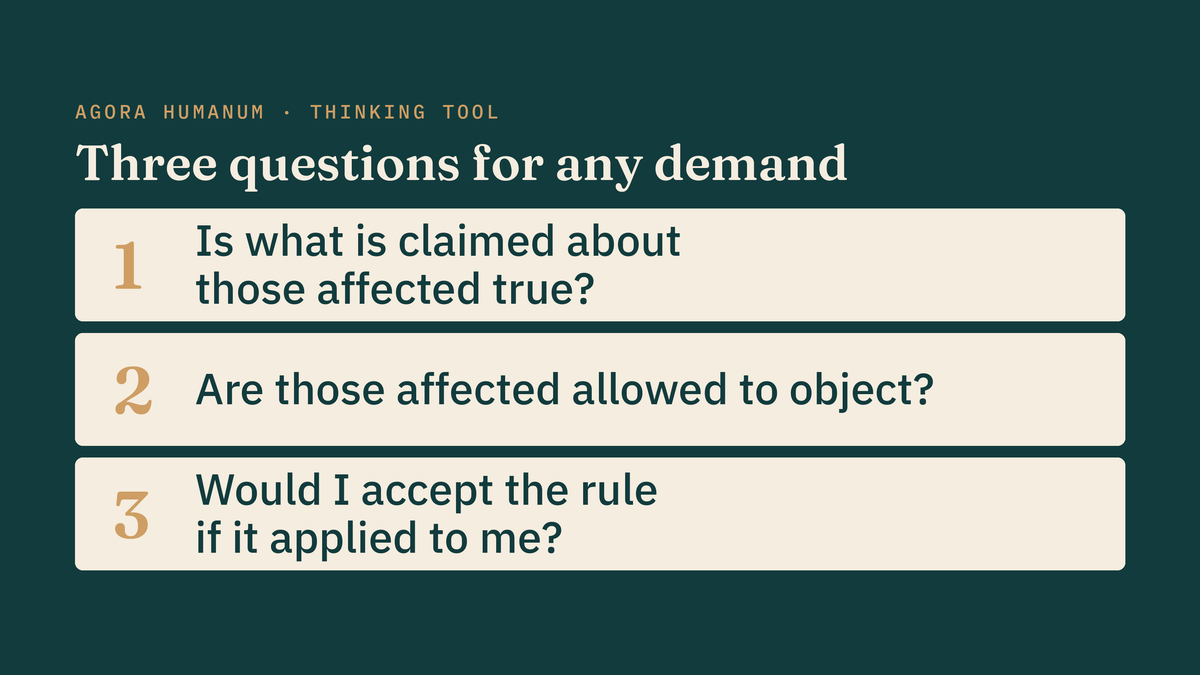
What would give either of you a reason to reconsider? I look at three things. Is the claim about the people affected true? Do they get to object? Would I accept the rule if it applied to me?
A historical source shows how little a moral justification proves on its own. In a speech to SS generals, Heinrich Himmler justified the murder of Europe’s Jews as a duty. What does his reasoning reveal when we examine it on its own terms?
They called it their duty
On 4 October 1943, Heinrich Himmler, the head of the SS, spoke to SS generals in Posen about the murder of the Jews. He said: “We had the moral right, we were obligated to our people to kill this people which wanted to kill us.” And he called the murder a “page of glory in our history” that “has never been written and will never be written”. Both quotations follow the English translation in the Encyclopedia of the United States Holocaust Memorial Museum. H. G. Adler quotes the German wording of the second one in a 1958 essay in the journal Aus Politik und Zeitgeschichte, citing the records of the Nuremberg trials.
Three things are contained in these sentences. A value that is not objectionable in itself: protecting one’s own people. A claim about the world that was false: that the Jews had wanted to kill the Germans. And the knowledge that the deed had to be kept silent.
Not everyone who took part was convinced. The historian Hans Mommsen writes in a survey of the research that ideological motives were not sufficient on their own. Many went along out of conformity or obedience. But the leadership’s justification was a moral one, and that is what this text is about.
Being convinced is not being right
If conviction were enough, nobody could ever be mistaken. Everyone would be right as long as they believed firmly enough. I have been convinced of things that were false.
Himmler, too, spoke of a moral right and not of one view among several. Whoever makes such a claim has to accept being tested.
What could be tested about their “good”
In three places the justification does not survive a test.
The facts were not true. The propaganda presented Germany as a victim and Jews as conspirators who had wanted the war. The Holocaust Memorial Museum describes that. A poster in occupied Poland read, in my translation: “Jews are lice; they cause typhus.” The museum documents it in its German-language article. The poster declares human beings to be vermin. Such sentences pose as facts, and they were false.
Objection was not possible. The regime called deportations “evacuation” and “resettlement”. In 1944 it dressed up the Theresienstadt camp specifically to deceive a Red Cross delegation. The museum describes that as well. Whoever deceives those affected and the public allows no objection.
The rule applied in one direction only. The same propaganda complained about wrongs done to Germany. So for its own people it held that human beings deserve protection. The Jews were denied exactly that protection.
One part remains, and I do not want to talk it away. The Nazis were not only mistaken. A society in which all people are equal was not their goal. Only those they regarded as “racially pure” Germans were to belong to the “national community” (Volksgemeinschaft). Everyone else was to be excluded, the Jews above all. That is how Germany’s Federal Agency for Civic Education sums it up. I read it this way: duties were to apply only towards one’s own. That was a decision about values. The last section is about it.
Three questions instead of a list of values
These three places become the three questions from the beginning. I put them to every demand that affects people, and to my own first.
- Is what is claimed about those affected true?
- Are those affected given reasons, and are they allowed to object?
- Would I accept the rule if it applied to me or my family?
Most political disputes are not settled by these questions. More cameras for more security, or fewer for more freedom? Help the people in your own country first, or everyone equally? As long as nobody says false things about others, denies them their rights or refuses to let them speak, this is an ordinary argument about what matters more to you. Only where that happens do the three questions raise the alarm.
I do not like to speak of “our values”. It sounds like property. A test has to be passed anew every time, by me as well.
The strongest objection
It goes like this: the three questions are themselves a value. They assume that every human being counts. That is exactly what the Nazis denied. The objection is correct. If someone does not accept that, no argument of mine can force them.
The questions are still not arbitrary. Because everyone demands them for themselves. Imagine you are given notice to leave your home over something you never did, and nobody hears you out. You would not accept that. Whoever expects others to put up with it has to be able to say what is different about them. The Nazis asserted such differences. They were false.
And what about someone who simply says the others just do not count? I cannot refute him. But then the only thing that counts is who is stronger, and he would have no right to complain when he himself is wronged. The perpetrators of that time did exactly that: they complained about wrongs done to Germans.
There are two things the three questions do not do. They do not tell me how animals, the unborn or future generations count. And I do not know whether they really tell anything apart in everyday life or whether in the end everyone claims to pass them. I have not found a study on that.
So I cannot force anyone to accept these three questions. But they lay open what they demand, and they apply to me first. Whoever shows me where they do not hold makes me change them. A mere opinion does not have to explain itself to anyone.
And today?
Today’s disputes are not those of that time, and I do not equate any camp of today with the perpetrators of that time. I take something else from the extreme case: your own clear conscience proves nothing. That holds for every side, including mine.
Consider the claim that everyone who votes for Germany’s AfD is a Nazi, or that every Green voter hates Germany. Each claim assigns a single belief to millions of people. It fails the very first question. The harder case is a policy I think makes sense.
Imagine your local council wants to close a square in the evenings because neighbours have complained about noise. You support the idea. What complaints have actually been made? Have the teenagers who meet there had a chance to suggest a solution? Would you support the same restriction on a place where you spend your evenings?
You may still think the square should close. But now you can say what facts you relied on, whose objection you heard and what restriction you would accept yourself. That is what I owe people when I ask them to live by a rule.
Sources and limits of this assessment
The text rests on six sources: three articles of the Encyclopedia of the United States Holocaust Memorial Museum (on Heinrich Himmler, on Nazi propaganda and on deceiving the public), a research survey by the historian Hans Mommsen (2007) and a text on the “Volksgemeinschaft” (2012), both published by Germany’s Federal Agency for Civic Education, and an essay by H. G. Adler (1958) in the journal Aus Politik und Zeitgeschichte.
Himmler’s two sentences are quoted in the museum’s English translation. I have not checked them against the German original of the speech. The poster text is my translation from the museum’s German-language article, and Hans Mommsen’s point is given in my own words. That duties were to apply only towards one’s own is my reading of what the sources say about the “Volksgemeinschaft”.
Himmler’s speech is a self-testimony before accomplices. It shows how the SS leadership presented the deed, and not reliably what each individual thought. How many perpetrators were convinced and how many went along out of conformity is disputed among historians. The philosophical question of whether a standard for all human beings can be compellingly justified is, as far as I can tell, not settled.
Research and drafting were AI-assisted. I correct errors visibly.
Written with support from generative AI. Editorial responsibility: Marcus Machon.