
Analysis
How fast can AI build the next AI?
Google has put an AI-designed improvement to work in training. Three findings help us judge whether gains like this can grow with each new generation.

In this essay
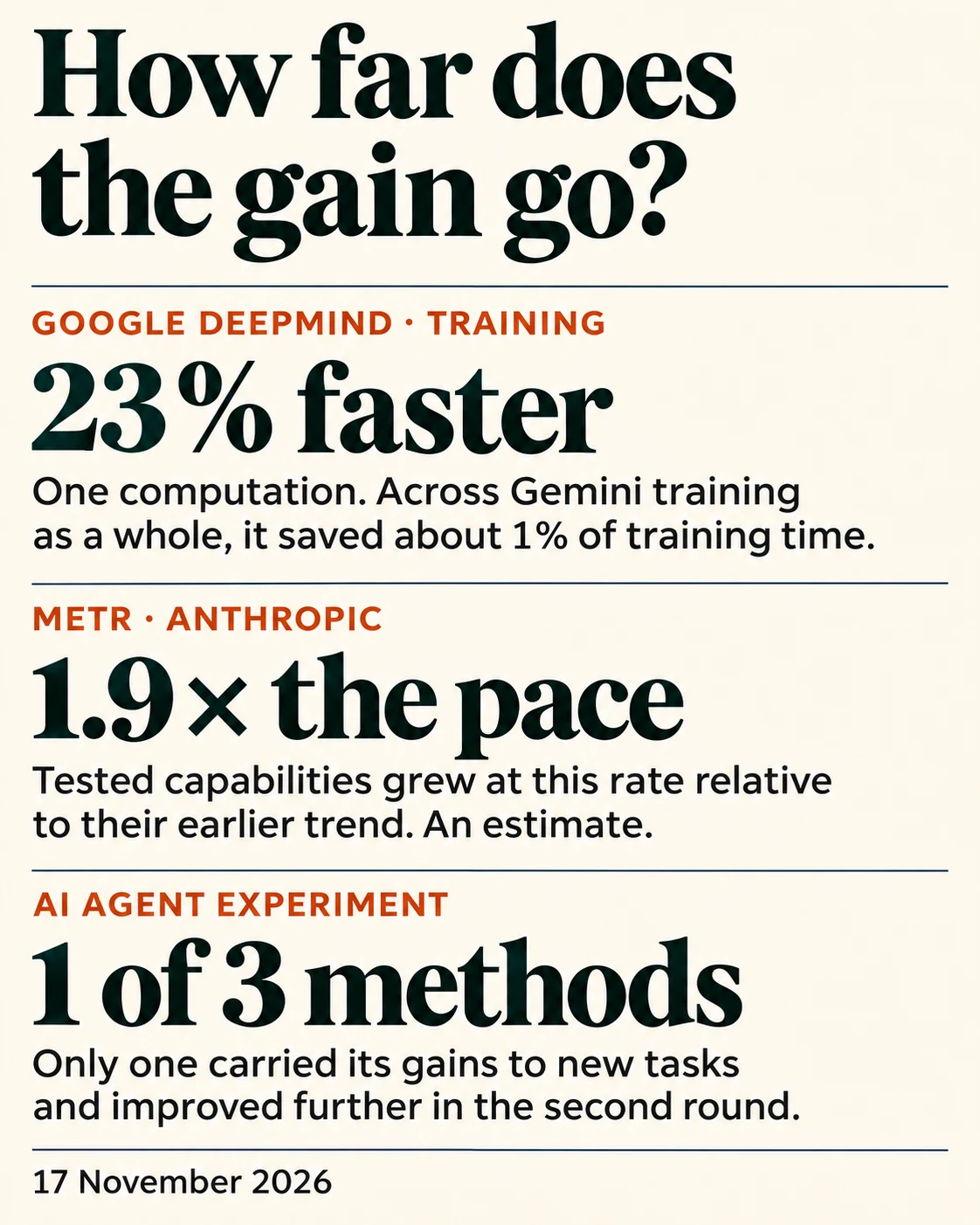
Google asked an AI to find a faster way to do part of the work of training Gemini. It found one. A frequently repeated computation ran 23 percent faster on average. Across the whole training run, that saved about one percent of training time. Google put the change into use. An AI had helped improve the process used to build the next AI. AlphaEvolve technical report, section 3.3.2
What happens to the time saved? If a lab uses it to run another experiment and that experiment clears the next bottleneck, development could pick up speed with each round. That is the idea behind an intelligence explosion. Two recent findings give us a way to judge how close we are.
What actually sped up at Anthropic?
On 5 November, the evaluation organization METR published its analysis of Anthropic. It estimated that, from around October 2025, the capabilities measured in model tests grew at 1.9 times their earlier pace, with an estimated range of 1.5 to 2.8 times. METR judged that AI assistance probably accounted for most of the acceleration. In most cases, AI was helping human researchers. Its causal contribution remains an estimate, and some of the underlying data are confidential. METR’s November assessment
How much sooner a lab can finish a research project is a different question. In June, Anthropic reported that, for the system it assessed at the time, it had yet to see a sustained doubling of its own research pace attributable to AI. Anthropic’s June system card
What survives the second round?
In one experiment, three methods improved how AI agents handled twelve computer tasks. The researchers then added ten unfamiliar tasks. Only one of the three methods carried its gains over to the new tasks and improved further in the next round. One design choice stands out. It rejected changes that made the agent worse at tasks it had already solved. The team behind the successful method reported the result. The experiment covered two rounds. Do Agent Optimizers Compound?
What would change my mind
Over the next few years, I think uneven progress is more likely than an intelligence explosion. I expect the biggest gains where an idea can be tested straight away. That is precisely why I take the prospect of rapid acceleration seriously. If AI improves a training method, a lab can try more ideas on the chips it already has. What matters then is who can check whether an apparent breakthrough holds up on an unfamiliar task.
I see a similar division of labor in my own system of AI agents. The agents are quick to implement a suggestion and measure what happens. The question of whether we are improving the right thing usually comes from me.
I would revise my judgment if an independent team showed, across several generations, that the time from an idea to a verified result kept shrinking, on tasks of comparable difficulty and counting failed attempts. That would tell us something a faster calculation alone never could.
Written with support from generative AI. Editorial responsibility: Marcus Machon.