
Perspective
What does our argument look like from six billion kilometres away?
The Pale Blue Dot does not settle a political question. It can change how we see what is at stake.
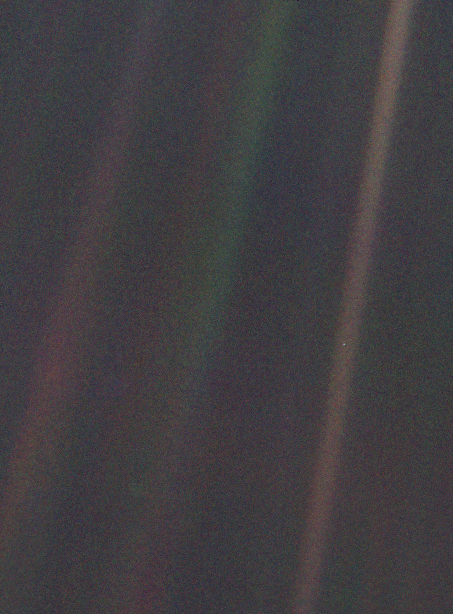
There is a dot. Barely visible. And on that dot, our lives unfold.
On 14 February 1990, Voyager 1 photographed Earth from roughly six billion kilometres away. The tiny point of light in a band of sunlight became known as the “Pale Blue Dot”. NASA describes the image and how it was made.
Distance does not make a life matter less
A person we miss. An animal seeking shelter. A forest we do not want to lose. None of these becomes unimportant because Earth looks tiny from far away.
For me, the image’s power lies in the opposite thought: what matters to us is here. It deserves our attention.
An image is not a political argument
The view from space cannot tell us which particular decision is right. That takes knowledge, reasons we can examine and people free to disagree.
My position: our differences are real. But no camp has an Earth of its own. Responsibility cannot stop at the edge of our group.
The cosmic calendar: a whole universe in one year
We can also look at time from an unfamiliar perspective. The cosmic calendar imagines the history of the universe as a single year: its beginning falls at midnight on 1 January, and the present at the end of 31 December. Every interval is shortened in the same proportion.
Our calculation uses 13.8 billion years and a year of 365 days. The rounded age follows the Planck results within the standard cosmological model, ΛCDM. It is a quantity inferred from measurements and a model. Planck Collaboration, Tables 1 and 2: age of the universe.
How do researchers arrive at that age? One important starting point is the cosmic microwave background: light from an early phase of the universe, whose temperature patterns Planck measured. Researchers examine which model parameters fit those measurements. The age is therefore part of a reasoned model calculation, rather than a reading from a stopwatch.
The cosmic calendar
13.8 billion years.
One single year.
From the beginning of the universe to today. And us? At the very end.
The whole year
1 January · Beginning31 December · Today
One day represents about 37.8 million years.
We zoom in on the final minute of the year.
The final minute
10,000 years ≈ 23 seconds
23:59:00Midnight · Today
The last 10,000 years fit into the bright section before midnight.
Now we zoom in on the final second.
The final second
80 years ≈ 0.18 seconds
23:59:59Midnight · Today
A full second represents about 438 years. An 80-year life fills only the bright section.
Now imagine the last 10,000 years. On this calendar, they fall entirely within the final 23 seconds before midnight. A period of 80 years shrinks to about 0.18 seconds. These are freely chosen intervals for illustration, not dates for the beginning of humanity or civilisation.
You can follow the arithmetic: 365 × 24 × 60 × 60 gives 31,536,000 calendar seconds. Dividing 13,800,000,000 years by that number gives about 438 actual years per calendar second. For the last 10,000 years, the calculation is 10,000 ÷ 13,800,000,000 × 31,536,000 ≈ 22.9 seconds. The figures are deliberately rounded.
What this compression shows — and what it does not
The calendar helps compare very different spans of time. It does not tell us that development inevitably led to us. The present only falls at the end of the year because we chose that boundary for the model. The future is open.
Our brief span does not make a human life worth less. For me, the thought experiment instead makes our limited opportunity to care for one another and our shared environment more tangible. That is my interpretation, not a finding of the cosmological measurement.
A question to take away
What would I like to preserve if, for a moment, I stopped trying to win an argument?
Perhaps a conversation. A part of the natural world. A person. Responsibility can begin there.
Written with support from generative AI. Editorial responsibility: Marcus Machon.
Which question will you take with you?
Bring your perspective →