
Analysis
Are foreign nationals more often criminal? What the research says and what it does not
According to German police, in 2025 foreign nationals living in Germany aged eight and over were suspected of a violent offence about four times as often as Germans in the same age range. My age-adjusted estimate is roughly three times. Around 994 in 1,000 foreign residents aged eight and over were not suspected of one that year. What age, living circumstances and reporting explain, what remains open and what the numbers do not say about individuals.

In this essay
- The key points in brief
- Terms that often get mixed up
- Why do so many people react so strongly to this subject?
- What do the numbers show?
- What explains the gap? Five objections examined
- Are foreign nationals also more often victims?
- Which conclusions hold, which do not?
- What I take from this
- How the research was done
I hesitated for a long time before writing about this subject. This text is meant as a basis for conversations in which both camps cite numbers that are correct and draw conclusions from them that go too far, in one direction as in the other. Behind the dispute stand two worries, and I think both are justified. The first is: am I still safe, are my children? The second is: am I suspected because of my origin, although I have done nothing? Silence calms neither worry. It leaves the subject to those who use a single number to stir up feeling. I therefore measure both sides by the same standard: what is true about it? How much does it explain? What remains open?
The text is mainly about violent offences. Foreign nationals living here are, relative to their numbers, suspected of a violent offence clearly more often than Germans. In this text I call that the gap. What is always meant is: how many times as often. Age, living circumstances and reporting explain part of it. Another part is unexplained, because data and research are missing. A judgment about people of one origin, or suspicion against everyone, does not follow from it.
I try to strike a compromise between readability and verifiability. Anyone who reads only the headings and main statements gets a simplified version. Anyone who doubts a statement will find in the expandable boxes the studies that speak for and against it, their methods, the links to the sources and the places where data are missing. At the end I assess how certain each statement is.
I researched and wrote the text with the help of AI. It is not a scientific work and not a peer-reviewed study. The most important numbers were checked against the original, and counter-evidence was searched for deliberately. Errors remain possible nonetheless. Notes and corrections are welcome, preferably via the page Take part, and I will amend the text. How the research was done is explained at the end. As of 23 November 2026.
The key points in brief
- The police statistics show a clear gap. In 2025, foreign nationals aged eight and over living in Germany were suspected of a violent offence roughly four times as often per capita as Germans in the same age range. A gap also appears in convictions for dangerous bodily harm among men aged 14 to 49 (2024, no restriction by residence). Other countries in Western and Northern Europe have it too, each measured somewhat differently; in the US, often not.
- Few are suspected. In a year, roughly 994 of 1,000 foreign nationals aged eight and over living here are not suspected of any violent offence. The values differ sharply by age, sex, nationality and reason for migration.
- The gap shrinks the more precisely one compares. Taking out the younger age structure leaves about three times the rate for violent-crime suspicion. That is my own recalculation, an estimate. How much living circumstances and reporting add in Germany, I have not found in any nationwide calculation. In Sweden, the ratio for suspicion of offences against life and health fell from 3.3 to 2.1 after adjusting for age, sex, income, education and municipality type. The study compared people born abroad with Swedish-born people whose parents were both born in Sweden. Among adolescents, reporting rates differ by the perceived citizenship of the offender. How much that contributes to the gap in police figures is unclear.
- Living circumstances have an effect. Studies of assigned neighbourhoods, legal residence, German citizenship at birth and cash benefits find changes for particular groups. In Denmark, assigned neighbourhood conditions also affected boys’ later convictions for violence and sexual offences. How much these circumstances explain of the German gap remains open.
- Part of it is unexplained. How large the gap among adults in Germany would be if everything were taken into account at once, I have found calculated nowhere. What remains after such a calculation shows what the calculation did not capture. Such a remainder proves neither that origin is the reason nor that it is all just measurement error.
- What the numbers do not permit: a judgment about the individual person, and the conclusion that origin or religion is the cause.
Terms that often get mixed up
| Term | What it means | Why it matters |
|---|---|---|
| Foreign national, non-German | People without a German passport | This is how the police statistics count. Anyone who has been naturalised or has had a German passport from birth counts as German, including children of immigrants. This also applies to dual nationals: anyone with the German passport and another one counts as German (Report on the Crime Statistics 2025, p. 72). |
| Migration background | Immigrated oneself or child of immigrant parents, regardless of passport | This is how many surveys and the Swedish statistics count. Whether one immigrant parent is enough or both are needed is handled differently. |
| Immigrants (term used by the Federal Criminal Police Office) | Asylum seekers, people granted protection, people with a tolerated stay (Duldung) and people without a residence permit | This is only a part of the foreign nationals. |
| Suspect | Someone whom the police, after their investigations, consider suspicious | This is not a verdict. Only some of the suspects are later convicted. |
| Violent crime | In the police statistics mainly: murder and manslaughter, rape and particularly serious sexual assault, robbery, dangerous and grievous bodily harm, hostage-taking | Simple bodily harm is not included. |
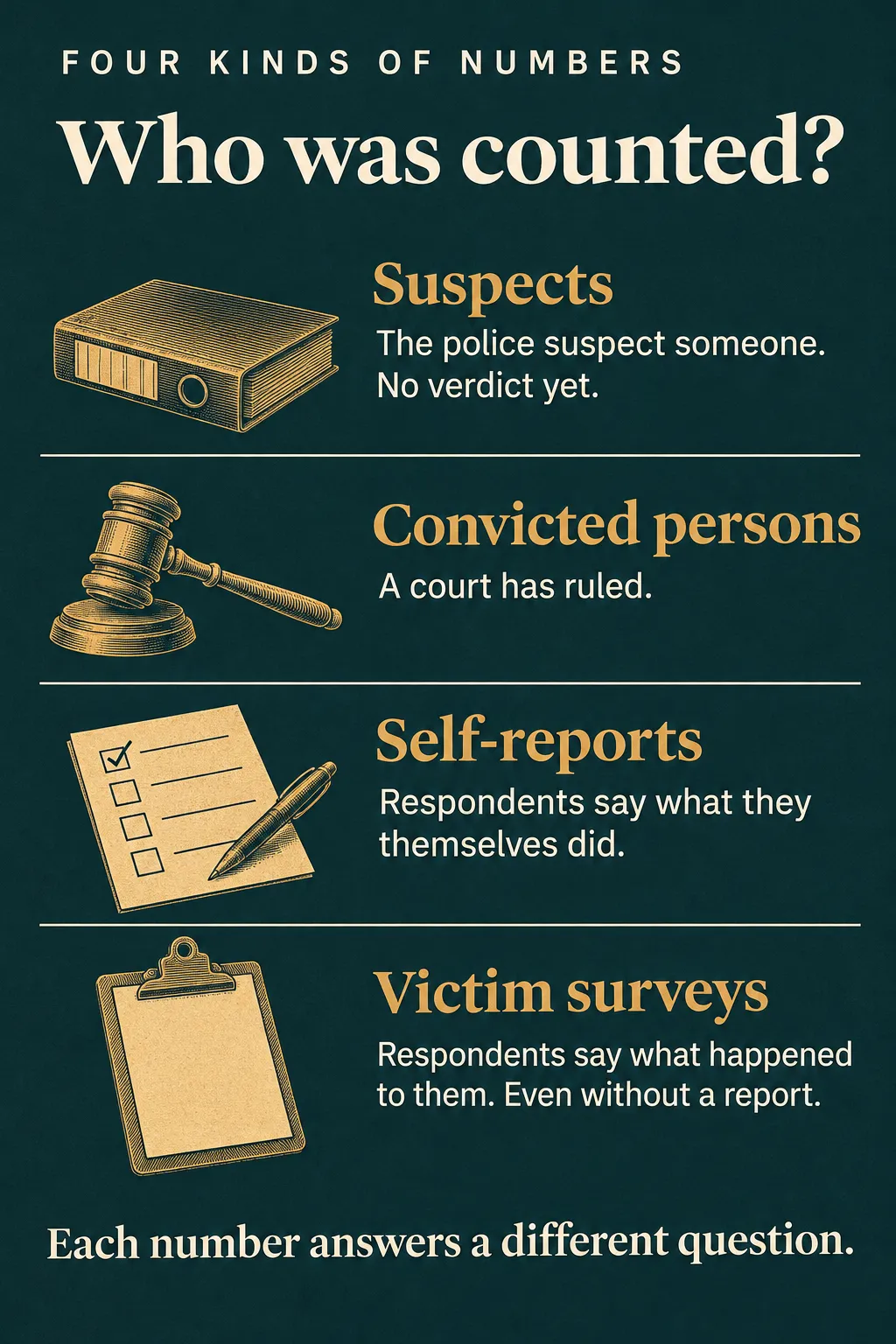
There are also four ways of measuring crime. The police count suspects. The justice system counts convicted persons. Surveys ask people whether they have used violence themselves. And they ask victims what happened to them. None of these ways shows the whole reality. That is why I state for every number which way it came from.
Why do so many people react so strongly to this subject?
Violence is about life and limb. Anyone who fears for themselves or their children does not want to hear a footnote. Anyone who is included in every headline because of their name or appearance hears an accusation in every number.
Why the debate in Germany is so heated remains an open question for me. What is documented: drastic individual cases shape how frequent people think a danger is. And in American experiments, the same information convinces people on the left and on the right more when it fits their own stance. In this text, therefore, numbers that one side does not like stand directly beside numbers that the other side does not like.
More on this: Two theses, experiments on individual cases and on motivated reasoning
I have two theses on this. Both are my own assessment. I have not substantiated them in this research.
The first: it is not only about safety. Some people feel that their country is changing faster than they like. This worry is hard to voice without being put into a box at once. A crime figure gives it something tangible.
The second: people draw conclusions from single experiences to different extents. Someone who has a bad experience with a person they take to be foreign, for instance because of appearance or language, easily transfers it to everyone who looks similar. Yet appearance does not tell whether someone has immigrated or whether their family has lived here for generations. With someone who looks like oneself, it tends to stay at “that one person”.
Something related is documented: drastic individual cases shape how frequent people think a danger is.
In an American experiment, people read newspaper reports about carjacking. When the report included examples with fatal outcomes, readers considered such outcomes more frequent, although the report also contained figures on the actual frequency (Gibson and Zillmann 1994). Only the abstract of this study was read. It comes from the USA and is not about immigration.
A Swedish experiment with 1,709 participants concerned the children born in Sweden to two immigrant parents (Lindgren, Theorin and Strömbäck 2026). In fact, 10.2% of them were suspected of a criminal offence within four years. The participants estimated the share far higher. Those who were told the actual values were still on average about 29 percentage points too high nine days later, those who were not told, about 38 percentage points. So the correction helped, but the overestimate remained considerable. What was measured was the estimate of a suspicion rate. How great the fear of violence is, the study did not measure. I checked the design and number of participants against the abstract of the study. I know the individual values from the research. They have not yet been checked against the full text.
And there is something I know from myself. When a number does not fit what I am convinced of, the most comfortable thing is to doubt the number. Or the person who cites it.
Psychology calls this motivated reasoning: the same information convinces us more when it fits our stance. An analysis of 51 experiments found this among left-liberals as among conservatives. A difference between the two camps could not be shown (Ditto and others 2019). The experiments come from the USA. Whether it is the same in Germany and on this subject, they do not show.
The analysis combines 51 experiments with over 18,000 participants in total. It examined whether people rate otherwise identical information more favourably when it supports their own political stance. On average, both camps did. The difference between them was small and statistically indistinguishable from zero. That means: a difference has not been shown. It is not proven by this that both camps distort equally strongly.
The analysis is contested. Critics consider the result a consequence of the selection of studies. They also object that part of the behaviour can be explained without wishful thinking: anyone who considers something unlikely for good reasons may examine counter-evidence more strictly (Baron and Jost 2019, “False Equivalence”, in the same journal). This critique was not read in full text; the analysis itself was read in a manuscript version. I have not found a comparable analysis for Germany.
That it is about safety, about belonging and about one’s own view of the world is my assessment.
What do the numbers show?
The most important source is the Police Crime Statistics (PKS). It counts suspects. So it counts neither convicted persons nor offences that never become known to the police.
In 2025 the police identified 192,239 people whom they suspect of a violent offence. Of these, 82,565 had no German passport. That is 43 in 100 (own calculation from the report by the Federal Ministry of the Interior and the Federal Criminal Police Office on the Police Crime Statistics 2025, table 4.4-T01a, p. 17). This share alone is not suitable for a comparison. It does not say how large the group is from which the suspects come. In addition, the suspects include people who do not live in Germany at all, for example people passing through. How many that is for violence, I have not found in the report.
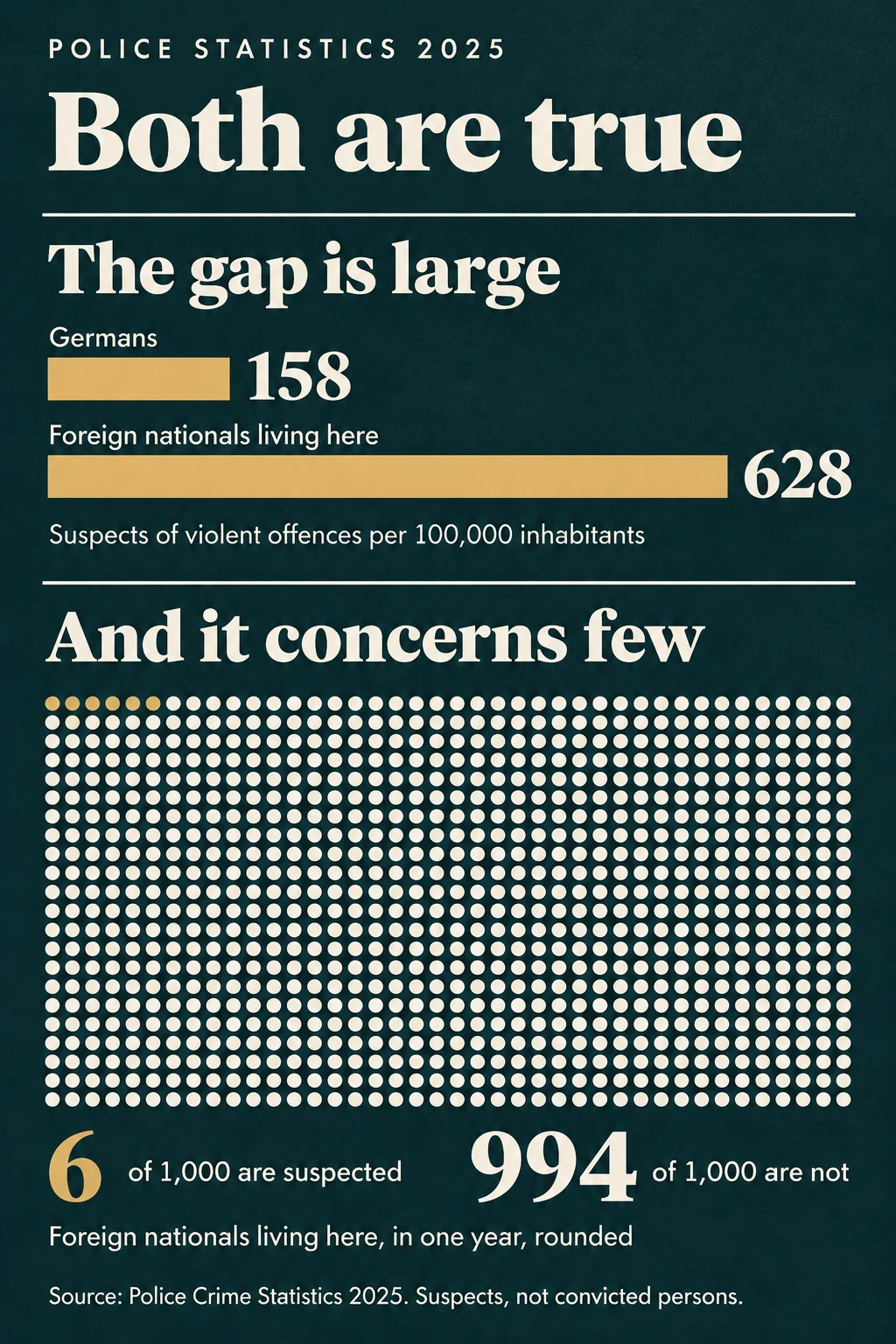
The comparison per inhabitant is more precise. For this, the Federal Criminal Police Office counts only suspects who live in Germany, and divides them by the number of inhabitants of their group aged eight and over. The result for 2025: of 100,000 Germans, 158 were suspected of a violent offence, of 100,000 foreign nationals living here, 628 (same report, pp. 51 and 52). That is roughly four times as many.
628 in 100,000 is about 6 in 1,000. In a year, then, about 6 in 1,000 foreign nationals living here are suspected of a violent offence and about 994 are not, so less than one in a hundred. For Germans it is about 1.6 in 1,000, so about a quarter of that. These are averages for a single year across all age groups from eight years and both sexes. For young men the values are markedly higher; I come to that in the section on age.
Both statements are true at the same time. Anyone who cites only the fourfold makes a whole population group look dangerous. Anyone who cites only the 994 in 1,000 makes the fourfold disappear.
More on this: How the rates were checked and how many of the suspects are asylum seekers and refugees
I checked whether the values are consistent: the rates for the individual age groups, weighted by population, add up to these overall values to within one percent. I could not recalculate the number of suspects who live here itself, because the report does not give it.
Roughly 30 in 100 non-German suspects of violent offences are immigrants in the sense of the Federal Criminal Police Office, that is asylum seekers, people granted protection, people with a tolerated stay or people without a residence permit (25,143 of 82,565, own calculation, same report, p. 17). Measured against all suspects of violent offences, that is roughly 13 in 100 (25,143 of 192,239). The remaining roughly 70 in 100 are, for example, EU citizens, foreign nationals who grew up here, people with a work or family residence permit and people without a residence in Germany. How often immigrants are suspected relative to their numbers cannot be read from this. Why, is stated at the end in the list of what is not known.
What the police figure cannot do
The report says it itself: the statistics are “not an exact mirror of crime reality” (pp. 6 and 7; my translation, as for all quotations from German sources). Three limits matter for this text.
- It counts suspicion, not a verdict. But a gap also shows among convicted persons, shown for dangerous bodily harm among men aged 14 to 49.
- It knows only what is reported or discovered by the police themselves.
- It counts by passport. It does not record a migration background.
More on this: The three limits in detail
First, the police count suspicion, not a verdict. The Munich criminologist Ralf Kölbel has therefore also analysed convicted persons (Kölbel 2026, Kriminalpolitische Zeitschrift, table 9). He compares only men aged 14 to 49 with each other. In 2024, non-German men of this age, relative to their number in the population, were suspected of dangerous or grievous bodily harm 3.0 times as often as German men. They were convicted of dangerous bodily harm 2.6 times as often. Kölbel could not filter by residence when comparing suspects and convictions. The two statistics also define the offences differently and do not follow the same cases. Whether the gap shrinks on the way to court can therefore not be read from this. What can be read: the gap is large among convicted persons too. That speaks against its arising only from hasty suspicion. But differences in reporting are also contained in the numbers of convicted persons, because cases must first come to the attention of the authorities. Police can also discover offences through their own investigations.
Second, the police know only what is reported or discovered by them. How much remains in the dark is shown only by surveys. I come to that further below.
Third, the statistics count by passport. They do not record a migration background. Anyone who has been naturalised or has had a German passport from birth is among the Germans.
Which violence is meant?
Anyone who thinks of violence thinks of robbery, brawls, rape, murder. The police statistics group under “violent crime” only the serious forms. Almost three in four cases are dangerous or grievous bodily harm. Dangerous means, for example: with a weapon, with a dangerous object or by several people together. A brawl without such circumstances is simple bodily harm. It does not count as violent crime and therefore is not part of the 158 and 628 per 100,000.
In each of these types of violence, the share of suspects without a German passport is far above their share of the population aged 14 and over, which is roughly 15% (as of 2024). This is also true of simple bodily harm, though somewhat less strongly there. The size of the per capita gap varies by offence.
More on this: Cases and suspects by type of offence and the gap per inhabitant
Violent crime in 2025 by type of offence: recorded cases and suspects (no verdict)
| Type of offence | Recorded cases | Suspects | Of these without German passport | Share without German passport |
|---|---|---|---|---|
| Dangerous and grievous bodily harm | 155,002 | 153,899 | 65,600 | 43 in 100 |
| Robbery | 40,119 | 30,752 | 14,959 | 49 in 100 |
| Rape and particularly serious sexual assault | 14,454 | 12,306 | 4,733 | 38 in 100 |
| Murder, manslaughter, killing on request | 2,453 | 2,893 | 1,358 | 47 in 100 |
| Violent crime in total | 212,335 | 192,239 | 82,565 | 43 in 100 |
| For comparison, not included: simple bodily harm | 432,049 | 343,700 | 123,838 | 36 in 100 |
| For comparison: share of the population aged 14 and over without a German passport (2024, according to Kölbel) | roughly 15 in 100 |
Source: Report on the Police Crime Statistics 2025, sections 4.4.1 and 4.4.2 (table 4.4-T01a, pp. 17 and 18). The shares are my own calculation, as is the population share (based on Kölbel 2026, table 3). The rows cannot be added up to the total, because a suspect can appear in several rows. Limits: suspicion, not a verdict. The shares also include suspects without a residence in Germany and do not say how often someone is suspected relative to the number of inhabitants.
The Munich criminologist Ralf Kölbel calculated the gap per inhabitant by type of offence for 2024:
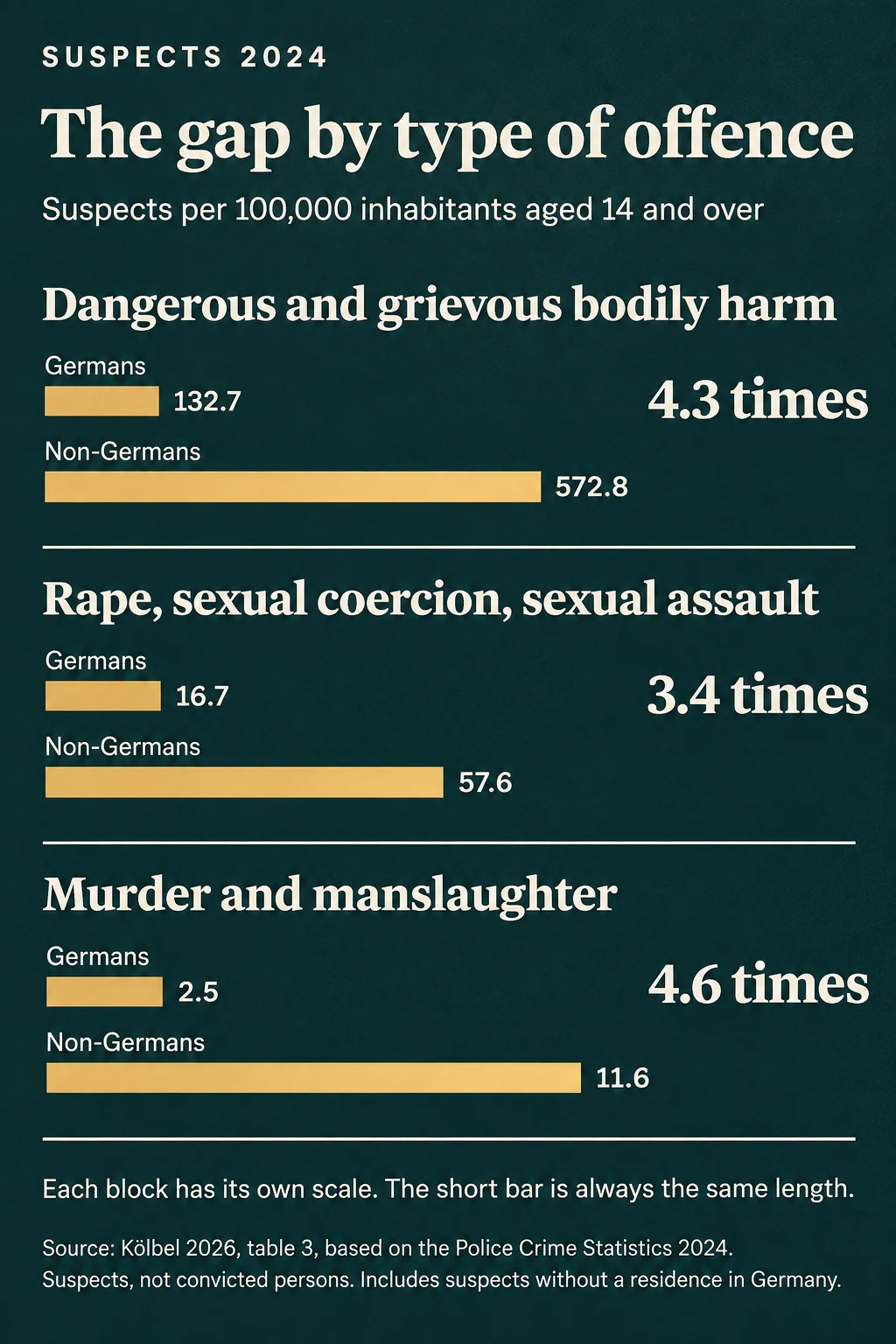
Values per inhabitant by type of offence are not in the Report on the Crime Statistics. Kölbel calculated them himself for 2024, per 100,000 inhabitants aged 14 and over, that is from the age at which one can be punished (table 3). The values are in the graphic. They also include suspects without a residence in Germany. My calculation for robbery in 2025 gives a ratio of roughly 5.4 for people aged eight and over, also including suspects without a residence in Germany (PKS T40/T50, GENESIS 12411-0007, annual average).
Murder and manslaughter
Relative to the number of inhabitants, non-Germans were suspected of a homicide offence in 2024 a good four and a half times as often as Germans. If one compares only men aged 14 to 49, it is a good three times. Most of the cases the police count here are attempts. In 2024, according to the Munich criminologist Ralf Kölbel, it was about three in four (p. 173). I mention this because “homicide offence” is often read as if a person had died every time.
More on this: Why murder and manslaughter separately, the values per inhabitant and the comparison with 2009
Murder and manslaughter make up a good one in a hundred cases of violent crime. I still treat them separately, because here the dark figure is likely to be smallest, that is the part of the offences the police never learn about. And in 2024 the police identified a suspect in about 94 of 100 cases (Kölbel 2026, p. 173).
In 2025 the police counted 2,893 suspects for murder, manslaughter and killing on request. Of these, 1,358 had no German passport (Report on the Crime Statistics 2025, p. 17).
For 2024 Kölbel arrives at 2.5 German and 11.6 non-German suspects per 100,000 inhabitants aged 14 and over (table 3). That is roughly 4.5 times. Kölbel gives 4.6 because he divides values that are already rounded, unrounded it is 4.54. Relative to the number of inhabitants, non-Germans are therefore suspected a good four and a half times as often. I recalculated Kölbel’s values. They match if one uses the older population figures based on the 2011 census, as he does. With the newer count from the 2022 census the gap is somewhat larger, at just under 4.8 times (12.2 to 2.6 per 100,000). That does not change the order of magnitude. I did not check the other offences one by one. Among non-Germans the share of men aged 14 to 49 is higher. If Kölbel compares only these men with each other, it is 3.3 times (table 9). Here too, these are suspects. Put differently: in 2024 there was, by Kölbel’s values, one suspect for roughly every 8,600 non-Germans aged 14 and over. Among Germans it was one for roughly every 40,000. With the population figures of the 2022 census it would be roughly 8,200 and roughly 39,000. The non-German figure also includes suspects who do not live in Germany, which raises it. In about three in four cases it remained an attempt. Attempted killings, too, often have serious consequences.
Kölbel also looked back. In 2009 the value was 11.8 for non-Germans and 3.2 for Germans. For non-Germans, then, it was about as high in 2024 as in 2009. For Germans it was lower. Between these two years the gap grew from 3.7 times to roughly 4.5 times, because the German value fell. I did not check whether the population figures of both years rest on the same census base. The comparison is therefore only approximate. What happened in the years in between and how the two groups changed over that time, the two values do not show.
Rape and other sexual offences
Hardly anything causes as much fear and anger as sexual violence. That is why I look more closely here, and not only at the serious cases.
In short: For rape, suspects without a German passport have a clearly higher share than in the population, and for offences committed by groups it is highest in the table in the expandable box. For child abuse and for depictions of child abuse it is somewhat above the population share, but much less clearly. In sexual offences with immigrant suspects, most victims were Germans.
For rape and particularly serious sexual assault, 38 in 100 suspects had no German passport in 2025.
More on this: The sexual offences in detail and whom they hit
Sexual offences and insults of a sexual nature in 2025: suspects (no verdict)
| Type of offence | Suspects | Of these without German passport | Share without German passport |
|---|---|---|---|
| Rape and particularly serious sexual assault | 12,306 | 4,733 | 38 in 100 |
| Gang rape and other serious sexual offences involving several people | 1,087 | 578 | 53 in 100 |
| Insult of a sexual nature | 26,462 | 7,185 | 27 in 100 |
| Sexual abuse of children | 12,823 | 2,463 | 19 in 100 |
| Distributing, acquiring or possessing depictions of child abuse | 34,819 | 7,786 | 22 in 100 |
| For comparison: share of the population aged 14 and over without a German passport (2024, according to Kölbel) | roughly 15 in 100 |
Sources: Report on the Police Crime Statistics 2025, tables 4.4-T01a, 4.4-T03, 4.4-T4 and 4.4-T12 (pp. 17, 24, 25 and 33). Gang rape: answer by the Federal Government, Bundestag printed paper 21/6858, in German. The shares are my own calculation. Limits as above: suspicion, not a verdict, and also suspects without a residence in Germany. The suspects also include children under 14, but the comparison value applies only from 14.
For the broader category of rape, sexual coercion and sexual assault, non-Germans were suspected almost three and a half times as often as Germans per inhabitant in 2024 (Kölbel 2026, table 3, see the graphic under “Which violence is meant?”). For gang rapes and other serious sexual offences involving several people, the Federal Government gives 751 cases and 1,087 suspects for 2025, 578 of them without a German passport. That is more than every second one.
For sexual abuse of children and for depictions of child abuse, the share is somewhat above the population share, but at 19 and 22 in 100 much less clearly than for rape. The great majority of the suspects here have a German passport. Anyone who talks about sexual violence should keep both in view.
The Federal Criminal Police Office’s situation report “Crime in the Context of Immigration 2025” shows whom sexual offences hit in which at least one immigrant was a suspect. As above, only asylum seekers, people granted protection, people with a tolerated stay and people without a residence permit count as immigrants, and it covers all sexual offences, not only rape. In 2025 there were 4,343 victims in solved cases. 2,941 of them were Germans, 650 were immigrants themselves, and the remaining 752 belonged to neither group (pp. 30 and 31). Unlike in offences against life with immigrant suspects (see below), most victims here are thus Germans. This distribution alone says nothing about the risk of an individual woman, because Germans are also by far the largest group in the country. The share of immigrants among all suspects of sexual offences was 7.5%, and thereby somewhat below their share of all suspects overall (8.2%, pp. 14 and 20). That is a comparison among suspects, not a measure of risk, and no all-clear. The 7.5% includes all sexual offences, also the many cases of depictions of child abuse. There the share of non-Germans is 22 in 100, lower than the 38 in 100 for rape. According to the police statistics, immigrants accounted for 5.3% of suspects for depictions of child abuse (1,846 of 34,819) and 11.2% for rape and particularly serious sexual assault (1,380 of 12,306, tables 4.4-T4 and 4.4-T01a). The largest group among immigrant suspects for sexual offences came from Syria (27.6%), followed by Afghanistan, Ukraine and Iraq (pp. 20 and 54).
More reports, but also more offences? The number of recorded rapes and particularly serious sexual assaults rose from 9,426 in 2019 to 14,454 in 2025 (Report on the Crime Statistics 2025, p. 10). The police name possible influences: the sexual offences law tightened in 2016 and more reports since the Me Too movement. The change in the law, however, came before both comparison years. In almost half of the cases recorded in 2025, the offence had happened in 2024 or earlier (46.1%, p. 19). Police statistics record cases after the investigation ends. The Federal Criminal Police Office says the share of these older offences rose, which may also reflect later reporting. These figures do not show how much the number of offences committed rose. Whether gang rapes have become more frequent since 2015, I cannot say with certainty either. I have not checked a continuous series against the original.
According to the police report, victim and suspect knew each other beforehand in about three in four cases of rape and particularly serious sexual assault, and most offences happened in a home (p. 19). There is no breakdown by passport for this. The report also does not publish a number of victims by passport for all sexual offences. For sexual harassment, for example in buses, trains or at festivals, it gives no numbers on the suspects. I have not evaluated the individual tables of the Federal Criminal Police Office for this.
What explains the gap? Five objections examined
Five objections to these numbers come up again and again in the debate. I examine them one by one.
Before the objections: what does “factoring out” mean? One compares like with like. An example with invented numbers: in group A, 50 of 100 people are young men, in group B 10 of 100. In both groups, every tenth young man is suspected of a violent offence and nobody else. Then group A has five suspects and group B one. That is five times as many, although the proportion recorded as suspects among young men is the same in both groups. If one compares only young men with young men, the gap is gone.
More on this: An example from Schleswig-Holstein and what "remainder" means here
In Schleswig-Holstein the ratio of suspect rates fell, across all criminal offences excluding immigration-law violations, from 2.8 times to 2.0 times when researchers calculated as if both groups were of equal age and equally often male. No difference would be 1.0 times. Of what lay above the German value, then, just under half dropped out. What remains after such a calculation I call the remainder. The remainder is the part of the gap that the examined characteristics do not explain. It can be large: here it is more than half of what lay above the German value. What it is due to, the calculation does not say. The remainder proves neither that origin is the reason nor that it is all just measurement error. It shows what the particular calculation did not capture, and how large it turns out depends on which data were available and how the calculation was done.
Is it because there are more young men among foreign nationals?
In short: In part. Young men are suspected most often in every group, and there are more of them among foreign nationals. But even if one compares only men of the same broad age group, non-Germans are suspected about three to four times as often. How much age explains, I have calculated myself: for violence the ratio falls from about four to about three. The calculation adjusts only for age. It removes about a third of the excess above parity. I have not found such a calculation by others for violence nationwide.
More on this: The numbers by age and sex
What is true: Young men are suspected of a violent offence most often in every population group, relative to their numbers. Among foreign nationals their share is higher than among Germans. The Report on the Crime Statistics itself names this as one reason (pp. 49 and 50).
How much it explains: Part of the gap, but not all of it. The comparison within equal groups shows this.
Violent crime 2025: suspects (no verdict) with a residence in Germany per 100,000 inhabitants of the respective group
| Group | German suspects per 100,000 | Non-German suspects per 100,000 | Non-Germans relative to Germans |
|---|---|---|---|
| All aged 8 and over | 158 | 628 | 4.0 times as high |
| Men and boys | 265 | 1,028 | 3.9 times as high |
| Women and girls | 58 | 187 | 3.2 times as high |
| Male adolescents, 14 to 17 years | 1,070 | 3,710 | 3.5 times as high |
| Young men, 18 to 20 years | 942 | 2,698 | 2.9 times as high |
| Men aged 21 and over | 194 | 808 | 4.2 times as high |
Suspects (no verdict) of violent crime 2025 with a residence in Germany per 100,000 inhabitants of the respective group. Source: Report on the Police Crime Statistics 2025, tables 6.5-T02 and T03, pp. 51 and 52. The right-hand column is my own calculation. The age groups are broad.
So even among men of the same broad age group, non-Germans are suspected about three to four times as often. The gap persists within these groups. How much age and sex explain in total, the table does not show. The age groups are too broad for that: “men aged 21 and over” ranges from the student to the pensioner, and the age distribution can differ between the two groups. I therefore calculated how much of this is due to the younger age structure, using 13 finer age groups than the report does. For violent crime in 2025, the suspect rate of non-Germans is roughly four times that of Germans. If one removes the younger age structure of the foreign population, about three times remains. The excess above parity falls from about three to about two, a reduction of one third. Direct standardisation requires an estimate of residence proportions within broad age groups. Social circumstances and reporting behaviour are not accounted for.
Sources: Police Crime Statistics 2025, tables T40 and T50, resident suspect rates according to the PCS 2025 report, table 6.5-T02; population by nationality and age: Destatis GENESIS 12411-0007, reference dates 31 December 2024 and 31 December 2025. Own calculation.
The age structures really do differ: of the inhabitants aged 8 and over, 21 percent of foreign nationals were between 18 and 29 in 2025, against 13 percent of Germans. At 60 and over it is 14 against 37 percent. From 2022 to 2025 this structure shifted so little that it would have changed the raw violence rate by about 2 percent at most (Destatis GENESIS 12411-0007, 31 December 2022 to 31 December 2025; own calculation based on PCS 2025).
The calculation does not hold only for violence as a whole. If one counts all suspects for the individual offence groups, that is including those not resident in Germany (for violence overall this gives roughly 3.3 times instead of 3.0), age explains between a quarter (theft) and a good third (sexual offences) of the excess above parity. A clear remainder stays in every group, from roughly 1.8 times for sexual offences overall to roughly 4 times for robbery. For the narrower police category of rape and particularly serious sexual assault, the same calculation gives roughly 2.6 times. How much age explains also depends on how finely it is divided: with fine age groups it is about a third of the excess above parity for violence, with only four coarse groups (up to 13, 14 to 17, 18 to 20 and 21 and over) it is less than 5 percent, because the rates keep falling noticeably beyond age 21 (own calculation based on PCS 2025, T40/T50, and GENESIS 12411-0007).
One caveat applies to these calculations, which I state once here: suspects are not convicted persons. Age is the only factor I have calculated out, not living circumstances, reporting behaviour or residence status. For individual offence groups the numerator also includes suspects living outside Germany. The effect on the ratio depends on the proportion of non-residents in both groups. They describe what is in the numbers and name no cause. The cut by Kölbel that I mentioned above is narrower: among men aged 14 to 49 it was 3.0 times in 2024 for dangerous and grievous bodily harm.
For all offences together, not only for violence, the Criminological Research Institute of Lower Saxony (KFN) has calculated more precisely. The study concerns Schleswig-Holstein and was paid for by the state criminal police office there (Research Report 161, figure 42, p. 94). In 2019, non-Germans there were suspected of a criminal offence 2.8 times as often as Germans per inhabitant. Violations of residence law are not counted here. The researchers then calculated as if the non-Germans were the same age and equally often male as the Germans. The gap fell to 2.0 times.
What remains open: I have not found a nationwide calculation of this kind for violence. The German age adjustment yields a smaller gap in recorded suspicion of violent crime. The table also shows differences among men within the same broad age bands. Neither comparison quantifies the combined contribution of age and sex to the nationwide gap.
Is it because of poverty and living circumstances?
In short: In part. Immigration and comparison groups can differ in income, education and place of residence. Register data show how far their suspect rates converge when measured characteristics are made comparable. In Sweden, people born abroad were suspected of a violent offence against life and limb 3.3 times as often as people who were born in Sweden themselves and whose parents were too. Equalising only age and sex leaves 2.8 times. Adding income, education and place of residence leaves 2.1 times. In this calculation and order, living conditions therefore contribute more to the narrowing than age and sex, and together they explain part of it, but not all. None of this excuses a crime. For Germany I have not found such a calculation.
More on this: The calculations from Sweden and other countries
What is true: The Swedish study records suspicion of an offence. It compares what happens to the difference when measured characteristics such as income and education are taken into account.
How much it explains: The most precise numbers come from Sweden, because registers for the whole population can be linked there. The Swedish crime authority Brå analysed about 8 million inhabitants aged 15 and over (Brå report 2021:9, table 1 and figures 7 and 10). It counts who was suspected of a criminal offence at least once between 2015 and 2018. People born abroad are compared with people who were born in Sweden themselves and whose parents were too. For violent offences against life and limb, people born abroad were suspected 3.3 times as often. The authority then calculates on a “what if” pattern, in two steps. If both groups were only of the same age and equally often male, 2.8 times would remain for violence. If they also earned the same, were equally educated and lived in the same kind of place, 2.1 times would remain (figure 10). Across all criminal offences the gap falls in the same way from 2.5 times to 1.8 times.
A Stockholm University research team compared convictions across levels of parental income (Bäckman and others 2021, tables 1a and 2a). The men were born from 1990 to 1993 and lived in Sweden continuously from age 15 to 24. By age 24, men born abroad were 1.9 times as likely to have at least one conviction as men born in Sweden with at least one Swedish-born parent (28.2% versus 15.1%). Among men with low parental incomes the ratio was 1.4 (43.1% versus 29.8%). The gap in percentage points was about the same in both comparisons. This analysis applies to all criminal offences, not specifically to violence.
For violence, people born abroad in Sweden were thus initially 2.3 above the natives’ value (3.3 instead of 1) and, after the calculation, still 1.1 above it (2.1 instead of 1). What lies above the natives’ value is, after the calculation, about half as large. The intermediate step shows where this comes from: age and sex reduce the excess from 2.3 to 1.8, a little over a fifth. Income, education and place of residence then reduce it by almost another third of the starting value. It is still not a clean division of causes. The characteristics are connected with each other, and calculated in a different order the shares could come out differently. Whether it would be similar in Germany has not been studied.
A more recent analysis arrives at partly larger shares for immigrant men. It compares convictions in five countries and was published by the Danish Rockwool Foundation (Andersen and others, Study Paper 283, figure 3). For immigrant men from countries that the study calls “nonwestern”, it calculates: if the recorded living circumstances were equal, the gap to the natives in the European countries would be more than halved. In Norway it would disappear. For the children of immigrants born in Denmark and the Netherlands, about a third would drop out. This calculation too applies to all criminal offences and not specifically to violence. And it too is a what-if model that does not prove causes.
What remains open: What stands behind the remaining gap and why it turns out so differently depending on country and measure. In addition, the Swedish authority itself calls its calculation a hypothetical result. For Germany I have not found an analysis of official data that, as in Sweden, links income and education with registered violent offences for each individual person.
There is also an objection that works in both directions. Income and education do not fall from the sky. Anyone who finds it harder to get a job or a flat because of their name is also poorer for that reason. Then poverty would be partly a consequence of disadvantage. Anyone who factors out poverty then factors out part of what they are actually looking for. Conversely, poverty can also be a consequence of an earlier offence.
Is it because foreign nationals are reported more often?
In short: Among young people there are indications that reporting plays a role. Its contribution remains unclear. In Lower Saxony in 2024, young victims without a migration background said police learned about roughly 22 in 100 violent incidents when they perceived the offender as having a migration background, compared with 8 in 100 otherwise. Sorted instead by the offender’s presumed citizenship, it was 20 versus 10 in 100 across all victims surveyed. Under the assumption used in the calculation, a ratio of about 1.7 would remain among boys, and in the same survey boys without German citizenship also reported their own violence more often, 14 versus 9 in 100, without anyone having to call the police. How large this difference is for serious violence among adults remains open.
More on this: Surveys on reporting, self-reports and police checks
What is true: Surveys of adolescents have shown this for years. The Criminological Research Institute of Lower Saxony asked adolescents whether they had been victims of violence and whether they had reported the offence. Three of these surveys are in the table.
How often the police learned about violent incidents, according to the young victims
| Survey | Respondents | Offender perceived as German or without a migration background | Offender perceived as non-German or with a migration background |
|---|---|---|---|
| Nationwide 2007 and 2008 | 44,610 ninth-graders | 19.5% | 29.3% |
| Lower Saxony 2015 | over 10,000 adolescents | 13.0% | 27.2% |
| Lower Saxony 2024 | 9,202 ninth-graders | 7.9% | 22.4% |
In 2007/08 and 2015 the comparison concerned German victims and offenders perceived as German or non-German. In 2024 it concerned victims without a migration background and offenders perceived as having or lacking a migration background. The report also counts cases where the offender was caught. Sample sizes refer to all respondents. Sources: Research Report 107, figure 4.7, p. 45. Expert opinion Pfeiffer, Baier and Kliem 2018, figure 35, p. 75. Research Report 171, figure 41.
The authors of the expert opinion summarise it thus: “The more foreign the offender, the more likely a report is made” (p. 74; my translation).
How much it explains: This is measured only for violence among adolescents. Serious offences are reported more often anyway, and as far as I can see this is not factored out in the values of the table. In addition, the victims estimate the offender’s origin and not his passport. Some of the offenders classified this way may have a German passport and then count among the Germans in the police statistics. For serious violence among adults I have found no comparable measurement. Kölbel therefore calls the explanation “plausible, but unresolved” (p. 174; my translation).
In the same survey, 5.7% of adolescents without a migration background, 8.3% of second-generation adolescents and 8.5% of those who had immigrated themselves reported at least one violent act in the previous year (Research Report 171, fig. 30). These answers did not depend on a police report. Just over half of the adolescents in the selected classes took part, and the questionnaire was only available in German. Adolescents with little German are therefore likely to be under-represented, as the report itself notes (pp. 25 to 31). The percentages cannot be offset against reporting rates: one question counts people reporting their own behaviour, the other asks victims about particular incidents.
A separate analysis of the same survey compared citizenship groups. Among male ninth-graders, 13.8% without and 8.6% with German citizenship reported a violent act, 1.6 times as many. Victims of both sexes said that 20.2% of incidents were reported when they took the offender to be non-German, and 9.8% when they took the offender to be German. The authors illustrate what would happen if the police rate for German boys doubled from 1.1% to 2.2%. The ratio would fall from 3.5 to about 1.7 (p. 10). Reporting rates describe incidents, while police figures count people. The data cannot determine whether the two change in proportion. It is the only German estimate of this kind I have found, and it is rough: victims guess the offender’s citizenship, the reporting rates come from Lower Saxony and are applied to nationwide police figures, the survey also counts less serious acts than the police statistics, and the authors give no range of uncertainty. That the result lies close to the 1.6 from self-reports is not independent confirmation: both figures come from the same survey and measure different things. The survey finds differences in reporting and in self-reported violence. It cannot establish how much reporting contributes to the gap in police figures.
Among boys outside academic-track secondary schools who expressed moderate or high acceptance of violence, both figures were around 17%. The difference was small in this subgroup. The analysis does not show how much school type and attitudes account for across all boys, or why those attitudes develop. School type alone narrowed the gap only a little: outside academic-track schools it was 14.6 versus 10.2%. A nationwide survey from 2007 and 2008 reached a similar picture with a statistical model. Once family violence, school type, welfare receipt, truancy, alcohol, violent media, masculinity norms and delinquent friends were taken into account, a migration background no longer had a detectable effect of its own (KFN Research Report 107, pp. 84 to 86). The report’s summary says the differences “even out completely” (finding 5). That goes beyond the main text, which speaks of a difference that is no longer significant. Some of these characteristics, such as delinquent friends, can also accompany violence rather than precede it.
How badly self-reports and police data can fit together is shown by a study from the Netherlands (Bezemer, Leerkes and Dykstra 2026, tables 4 and 5). The analysis links survey answers from 5,078 adolescents aged 12 to 18 to police records. At the same age and sex, the expected number of suspect registrations for adolescents from four immigrant groups was a little over four to seven times that for adolescents without a migration background. They also reported serious offences and serious violence more often. Adding self-reports reduced those ratios by 9 to 14%. With socioeconomic circumstances, residential environment and other characteristics included, the expected number was 1.6 to 2.6 times as high. What stands behind this remainder, the study leaves open. It may be due to recording, but also to self-reports being incomplete. The authors expressly do not treat it as a measure of discrimination. The study concerns all offences, not only violence. It is a single study from another country.
There is also an effect in the other direction. According to Kölbel, non-German victims tend to report less often (p. 174). Since many offences happen within the same group, offences by non-German offenders could thereby remain undiscovered. This too is not quantified.
And checks by the police? Kölbel also addresses the question whether the police more often check people they take to be foreign. For serious violence this has, in his assessment, “a rather limited significance” (p. 173; my translation). More important could be whether evidence is gathered equally thoroughly in investigations against Germans and non-Germans. According to Kölbel there is hardly any research on this. Whether the police check people of foreign appearance more often without an objective reason could be tested with hit rates: is something found less often among those checked more often? I have not found such data for Germany.
What can comparisons across countries tell us? In the United States, immigrants are often less likely to be recorded than people born there. In Sweden, the proportion registered as suspects varies strongly by region of birth. People born in East Asia, the Nordic neighbours or the older EU member states were suspected of an offence about as often as natives, across all offences (section “Is it the same in other countries?”). Recording that hits everyone born abroad equally more often could only explain this if people from these regions actually committed fewer offences than natives. The values, however, are not adjusted for age and living conditions. Whether recording affects people differently depending on appearance or origin, the comparison does not show. These records show whom the authorities register. To assess the role of reporting, we would also need to know which comparable incidents never reach the police and how those involved are perceived. These country figures cannot establish how much reporting contributes to the gap in Germany.
What remains open: Reporting and self-reports differ among young people. How much of the gap is due to recording and how much to behaviour remains unclear. The surveys from 2007/08, 2015 and 2024 all come from the same institute and use similar questions. They therefore do not confirm each other as independently as three studies by different teams would. How much reporting and police investigations contribute to the nationwide gap in violent-crime suspicion among adults, I cannot derive from them.
Is it because of war and flight?
In short: Swiss research gives reason to take exposure to war seriously. It compares male asylum seekers born in different years in the same country of origin. From 2009 to 2016, the estimated annual share with at least one police registration for a violent offence was 1.1 percentage points higher for war-affected cohorts. The sample average was 3.1%. Because the study does not measure who personally experienced war, the link may be larger for those actually affected. German rates by citizenship alone tell us neither who personally experienced war nor how much of the gap such exposure might explain.
More on this: The Swiss study and the numbers from Lower Saxony
What is true: A research team around the economist Mathieu Couttenier examined asylum seekers in Switzerland from 2009 to 2016 (Couttenier and others 2019, American Economic Review). For male asylum seekers whose home country experienced civil war or mass killings when their birth cohort was aged 1 to 12, the estimated share recorded by police for at least one violent offence in a given year was about 1.1 percentage points higher than for later-born cohorts from the same country. That difference amounts to about 35% of the sample mean of 3.1%. Individual exposure to war was not measured. For women the team found no such effect. In cantons where asylum seekers were allowed to work early, the surcharge was two thirds smaller. It is not an experiment. Because it compares birth cohorts from the same country, however, the study comes closer to a causal statement than a simple comparison of groups. The German Report on the Crime Statistics also names own experiences of violence and psychological strain from flight as a risk. It stresses that these are “no direct causes” (pp. 49 and 50; my translation).
How much it explains: A comparison of citizenship groups cannot identify individual exposure to war or its effect. Consider Lower Saxony in 2016 (Pfeiffer, Baier and Kliem 2018, p. 77). People from the war countries Syria, Iraq and Afghanistan made up a good half of the asylum applicants there (54.7%). Of the solved violent offences in which a refugee was suspected, however, only a good third fell to them (34.9%). Asylum applicants from Algeria, Tunisia and Morocco made up 0.9% of the refugees and 17.1% of these cases. What is compared here are shares of people with shares of cases. A few people with many offences can raise a share of cases strongly.
Part of this difference is due to age and sex. Among the North Africans about every second person was a man between 14 and 29, among the war refugees every fourth. The authors also interpret the difference thus: war refugees did not want to “endanger their good prospects of being allowed to stay in Germany through violent acts” (p. 82; my translation). That is their interpretation. They did not measure it.
The distribution by country of origin alone does not show how much war experience explains. It shows only that the highest values among refugees at the time were not among the war refugees.
The nationwide numbers for 2025 fit both. Men and boys from Syria, Iraq and Afghanistan were suspected of a violent offence, relative to their numbers, eight to ten times as often as German ones. Men and boys from Ukraine, many of whom also fled a war, a good three times as often (table in the expandable box of the section on “the foreigners”). The comparison measures citizenship. Individual exposure to war within each group is unknown. Age and living circumstances are not factored out in these numbers.
Why the comparison with Ukraine is flawed: among the refugees from Ukraine there are many women and children. The table counts only men and boys aged 8 and over, but these too can be composed differently, for example by age: if there are many boys and older men among them, that pushes the value down. And the conditions are different: refugees from Ukraine received a right of residence without an asylum procedure and were allowed to work immediately. That early work can play a role is suggested by the Swiss study. How much of the difference is due to who came, how much to the conditions here and how much to formative influences from the country of origin, none of the analyses I found separates.
What remains open: The Swiss study determines war experience through country of origin and birth cohort, not for the individual person. And it applies to Switzerland. For Germany I have not found a comparable analysis.
Don’t studies show that more immigration does not lead to more crime at all?
In short: These studies answer a different question. They ask whether crime in a district rises when more foreign nationals live there. After accounting for local differences, the ifo study found no statistically detectable association with recorded crime per resident. A Mannheim study finds more registered violent cases where more people seeking protection arrived. The two measure different things. That foreign nationals are over-represented among suspects is written by the authors of the ifo study themselves.
More on this: What the regional studies measure
What is true: The ifo Institute compared all German districts from 2018 to 2023 (Adema and Alipour 2025). In the cross-sectional comparison, districts with a higher share of foreign nationals recorded more offences per resident. The authors found no statistically detectable association when they examined changes within districts.
How much it explains: For the question of this text, little, because the study answers a different question. It asks: does crime in a district rise when more foreign nationals live there? This text asks: are foreign nationals suspected more often relative to their number of inhabitants? The authors themselves write that foreign nationals are over-represented among suspects. Anyone who cites the study as proof that there is no gap reads more into it than it says.
What remains open: Another regional study finds a rise. It studies newly arrived asylum seekers in a different period. The ifo study looks at the share of foreign nationals already living in each district. The Mannheim Centre for European Economic Research (ZEW) analysed 394 districts from 2013 to 2018 (Lange and Sommerfeld). For every ten additional arrivals of people seeking protection per 100,000 inhabitants, an estimated 0.73 additional registered violent cases per 100,000 inhabitants followed in the next year (table 4). That is an estimate that depends on the study’s assumptions about the distribution of people seeking protection.
A second study asks a narrower question (Huang and Kvasnicka 2026, table 7). It looks at districts with stronger refugee inflow in 2015 and only solved cases of robbery and of certain bodily harm and sexual violence offences. It does not find a secure rise in the number of German victims in cases with refugee suspects. That does not rule out a smaller rise. Both findings can be true at the same time. A registered case can remain unsolved or hit a victim who is not German. Both studies partly use the same data.
What remains after the five objections?
In short: Part of the gap can be attributed, part cannot. By my estimate, age accounts for about a third of the German gap above parity in violent-crime suspicion. In Sweden, the relative suspicion rate for offences against life and health among foreign-born people fell from 3.3 to 2.1 after adjusting for age, sex, income, education and municipality type. The comparison group was born in Sweden to two Swedish-born parents. Among adolescents, reporting rates differ by the perceived citizenship of the offender. How much that contributes to the gap in police figures is unclear. For violent crime across Germany I found no study that measured all these factors together with reporting patterns and individual exposure to war. Studies that exploit a kind of chance show an effect on recorded crime for individual living circumstances such as neighbourhood, legal residence and citizenship, within particular groups and offence categories. They do not quantify what share of the German gap this accounts for.
More on this: What the remainder means and what it does not
Type of school and social status on their own reduce the difference in the surveys of adolescents only slightly. In models that also take into account family violence, friends and attitudes to violence, it is no longer detectable. Not detectable does not mean equal, though, and the model does not show which of these characteristics is causal.
In most calculations from other countries a difference remains after adjustment, in Sweden for example 2.1 times for suspicion of violent offences. There is a counter-example, though: in Norway the gap in convictions across all offences disappeared for immigrant men from countries the study calls “nonwestern” once the recorded living circumstances were made comparable. The size of a difference depends both on the reference group and on which characteristics enter the comparison.
A difference left over in a model tells us little about its cause. If the difference disappears, it still takes other evidence to identify a cause or an intervention that reduces violence. Self-reported behaviour, police suspicion and criminal convictions measure different outcomes. Results from these studies cannot be added together to produce an estimate for Germany.
More reliable than such calculations are studies that exploit a kind of chance, such as an official assignment of where people live or a rule change on a cut-off date. They show an effect for individual living circumstances. In Denmark, refugee families were assigned to places of residence. Boys who grew up in places where more young people had been convicted of violent crimes were later more often convicted themselves, counting all offences; for girls, the effect on overall convictions was statistically uncertain (Damm and Dustmann 2014, tables 3 and 5). The study also finds more convictions for violent or sexual offences among boys (online appendix, table A11). In Italy, men whose applications for a residence permit arrived just before a quota filled were 0.3 percentage points less likely to be recorded by the police for selected serious offences in the following year than men who applied just after it filled. For men whose permit depended on the cut-off, Pinotti estimates the effect of the permit at a reduction of 0.6 percentage points from a baseline of 1.1 percent (Pinotti 2017, p. 153, table 3). The decline for murder and sexual offences was statistically uncertain (table 6). An earlier study by the same researcher uses the EU enlargement of January 2007. Among people released from Italian prisons, rearrest fell significantly only for those with previous economically motivated offences when their country of origin joined the EU and they gained legal status (Mastrobuoni and Pinotti 2015, table 3). Add to this the Swiss study on war-affected birth cohorts and the study on German citizenship from birth (sections “Is it war and flight?” and “What helps?”). Such studies show that individual living circumstances can change crime, each under the conditions studied. The results vary by group and offence. How much these circumstances together account for of the German gap remains open.
Is it the same in other countries?
In short: Yes, in Western Europe and the Nordic countries the gap exists too. In the USA, by contrast, immigrants are often registered less often than people born there. In Sweden, Norway and the Netherlands the gap gets smaller when one takes age, sex and living circumstances into account. How much remains depends on the country, the measure and the group. For Germany I have not found such a calculation with official data.
More on this: What international overview works say
Major overview works show the same picture. They separate two questions. The first: are immigrants registered more often than natives? In Western Europe and the Nordic countries on average yes, in the USA often no. The second: does crime in a region rise when more immigrants live there? For the USA most studies find no rise. In Europe the picture is mixed, and after the large refugee inflows of 2014 to 2016 some studies show more registered violence in the short term. The two questions measure different things and therefore do not contradict each other.
The Swedish crime authority summarised the international research in 2025 (Brå report 2025:7). In comparisons of persons from Western Europe and the Nordic countries, people born abroad are on average registered more often, in the USA often less often. The gap varies with the reason for immigration, the offence and the conditions of reception. In comparisons of regions, the methodologically stronger European studies often find no demonstrable effect for ordinary inflows. For the large refugee inflows around 2014 to 2016, some report short-term rises, also for violence. On Germany the report places studies with different results side by side.
For the USA there is an analysis that pools many studies (Ousey and Kubrin 2018). It covers 51 studies with 543 estimates. On average, immigration and crime in an area are almost unrelated: the value is minus 0.031 on a scale from minus 1 to plus 1. For violence it is indistinguishable from zero. This applies to areas in the USA. It says nothing about the suspicion against individual persons or about Germany.
For Europe the research is thinner. An overview from 2024 (Atsızelti) sorts 40 European studies that follow developments over time by their direction: 13 find an association with more crime, 15 with less, for 12 it depends on further conditions. The count does not take into account how large the effects are.
The numbers in this expandable box were checked against the original works in the research.
More on this: Norway and Sweden in detail
An example from Norway shows how strongly the reason for immigration separates the values (Statistics Norway, table B2). Of 1,000 immigrants who lived in the country at the beginning of 2010, 67 were registered as accused of at least one criminal offence within four years. If the statistics agency calculates as if age, sex, place of residence and employment status were equal, it is 54. In the rest of the population it is 45. For people who had come as refugees, the adjusted value is 85 in 1,000, for labour migrants 35. These numbers too apply to all criminal offences, not specifically to violence.
The Swedish data also show how different the groups are. The authority analysed by region of birth who was suspected of a criminal offence at least once in four years, here across all offences (Brå report 2021:9, figure 8). The share ranges from about 3% to about 19%. It is lowest for people from East Asia, from the fifteen older EU states and from the neighbouring Nordic countries. They are about on a par with the report’s comparison group, that is people who were born in Sweden themselves and whose parents were too. The share is highest in the group the report calls “rest of Africa”. If the authority calculates as if age, sex, income, education and place of residence were equal, the range still runs from about 3% to about 10%. The calculation specifically for violence is above: 2.1 times remains instead of 3.3 times (figure 10).
A further finding concerns the children born in Sweden to two immigrant parents. Across all criminal offences they were suspected 3.2 times as often as the comparison group. That is more often than for the immigrants themselves (2.5 times). After the what-if calculation, 1.7 times remains for them and 1.8 times for the immigrants themselves (figure 7). The gap thus does not end with the immigrant generation. Why that is, the calculation does not answer.
Are foreign nationals also more often victims?
In short: There is an indication, but no proof. In 2025 roughly 26 of 100 victims recorded by the police had no German passport. The count covers all offences with recorded victims, including non-violent offences. Among residents aged 14 and over, roughly 15 in 100 had no German passport in 2024. These figures cannot establish a victimisation rate. In cleared cases with at least one suspect in the police report’s immigrant category, about one in three recorded victims was in the same category. It includes asylum seekers, people granted protection, people with a tolerated stay and people without a right of residence.
More on this: Why I include this and why a victim rate cannot be calculated from this
Why I include this: the dispute is almost always about foreign nationals as offenders. That they are probably also over-represented among victims rarely comes up, in my impression. This matters for both worries from the beginning. Whoever reduces violence by immigrants also protects immigrants. And whoever looks only at offenders overlooks victims who report less often and are therefore more likely to be missing from the statistics.
In 2025, 26.1% of all victims recorded by the police had no German passport (Report on the Crime Statistics 2025, p. 62). The share of non-Germans among inhabitants aged 14 and over was roughly 15% in 2024 (own calculation after Kölbel, table 3). But the number of victims in the report covers all criminal offences for which the police record victims, and also people without a residence in Germany. A victim rate by passport, relative to the number of inhabitants, the police do not publish.
My conclusion from this: the numbers suggest that non-Germans are also over-represented among victims. It is not proven by this. The two numbers come from different years and have different age limits. A comparable victim rate cannot be determined from them. According to Kölbel, non-German victims also tend to report less often (p. 174). Then their share would in reality be rather higher than in the statistics.
Some of the offences hit immigrants themselves. According to the Federal Criminal Police Office’s situation report “Crime in the Context of Immigration 2025”, in offences with immigrant suspects about every third victim was an immigrant themselves (32.4%). About every sixth offence of the “Rohheitsdelikte” category with immigrant suspects took place in an accommodation or other social facility (16.4%). Neither figure applies specifically to violence. The first covers all criminal offences for which the police record victims. “Rohheitsdelikte” is a collective group of the police statistics that also includes simple bodily harm, coercion and threats. It is not the same as the violent crime that the rest of this text is about.
And what about murder and manslaughter?
In short: In homicide offences in 2025, the share of non-Germans among recorded victims was higher than in the population. For completed offences the gap is small and grows when attempts are included. A victim rate cannot be read from this. The Federal Criminal Police Office defines “immigrants” by residence status. In solved offences against life with at least one suspect in this category, more victims were immigrants themselves than German citizens.
Every one of these offences is one too many, whoever it hits. That many victims are immigrants themselves does not make any offence against a German smaller. But it shows this: in solved offences with immigrant suspects, 188 of 434 victims were immigrants themselves, attempts included. Immigrants here means: asylum seekers, people granted protection, people with a tolerated stay and people without a residence permit. Whoever reduces this violence therefore protects them too.
More on this: The victim figures for homicide offences and what they do not show
In 2025 the police counted 1,004 victims of completed homicide offences, that is murder, manslaughter and killing on request. These are counts of victims, and what exactly lies behind them I explain below. 198 of them had no German passport, which is roughly 20 in 100. Including attempts, it was 1,236 of 3,456 victims, roughly 36 in 100. For comparison: among inhabitants aged 14 and over, roughly 15 in 100 had no German passport (2024, according to Kölbel). Of the 1,236 non-German victim records including attempts, 168 were for Syrian citizens and 164 for Turkish citizens (Police Crime Statistics 2025, victim table 911, own calculation).
The Federal Criminal Police Office’s situation report “Crime in the Context of Immigration 2025” shows whom such offences hit when immigrants were suspects. There, only asylum seekers, people granted protection, people with a tolerated stay and people without a residence permit count as immigrants. In solved offences against life with at least one such suspect there were 434 victims in 2025, attempts included. 188 of them were immigrants themselves, 111 were Germans, and the remaining 135 belonged to neither group. For completed offences it was 25 immigrants and 10 Germans (pp. 30 and 31). The Federal Criminal Police Office writes: “A considerable share of the offences takes place within migrant groups” (p. 30).
What these numbers do not show: The police statistics count victims of completed and attempted offences. How many of these victims died, they do not state separately. Anyone who becomes a victim several times is counted several times. And a case appears only in the year in which the police close their investigation (Report on the Crime Statistics 2025, pp. 7 and 11). As with all victim numbers by passport, people without a residence in Germany are counted too, so this is not a victim rate. The numbers from the situation report apply only to solved cases and only to the narrow group of immigrants as defined in the situation report, not to all non-Germans. And a case counts there as soon as at least one immigrant is a suspect.
Whether someone is more likely to be killed by a stranger or by an acquaintance, and how often that is the case with German and non-German suspects, cannot be read from the published tables. They do not break down the relationship between victim and suspect by passport. For completed homicide offences in 2025 they show only that somewhat more than half of the victims were women (51.7%, p. 63).
What does the case-file study on femicides show?
In short: In a large case-file study of attempted and completed killings of women, people born abroad were strongly over-represented among offenders and victims when the offence against a partner was about separation or infidelity. Across all femicides in the study, too, 38 in 100 offenders had no German passport, against roughly 12 in 100 in the population. The majority therefore had a German passport, including naturalised people.
More on this: The case-file study on femicides in detail
The study analysed criminal case files on attempted and completed homicide offences against women that were recorded in 2017 in Baden-Württemberg, Lower Saxony, Rhineland-Palatinate, Saxony and six large cities in North Rhine-Westphalia (Rebmann and others 2025, in German, University of Tübingen and Criminological Research Institute of Lower Saxony). 292 cases were analysed, about a third of all such cases in Germany in that year (p. 10). After removing recording errors and cases without proof of the offence or without intent to kill, 197 killings and attempted killings remained (p. 24). The researchers rated 133 of them as femicides. Their concept is broad: it includes, for example, every killing of a partner or ex-partner, even without a proven misogynist motive (pp. 20 and 21). 108 of the femicides happened in or after a partnership. In 78 of them it was about a separation or infidelity, real or only feared by the offender (p. 29). In this group, two thirds of the offenders (52 of 78) and more than half of the victims (43 of 78) were born abroad and had immigrated themselves (p. 47). In the population this applied in 2017 to roughly 16 in 100 people (p. 47). That is only a rough classification, not a rate, because age and sex are not taken into account. A quarter of all 78 offenders had come to Germany only in the six years before the offence, mostly together with their partner (p. 47).
Across all 133 femicides, 62 in 100 offenders had a German passport and 38 in 100 did not (p. 48). In the population, about 11.5 in 100 people had no German passport in 2017 (p. 47). That too is only a rough classification, because the population also includes children and women. About half of the offenders had no immigration history, neither themselves nor in the family (p. 48). The offenders came from many different countries. The authors write that the offences cannot be explained “one-sidedly by culture”, and name a poor social situation and mental illness as further risks (pp. 4 and 48). But they also describe that emigrating together from a strongly patriarchal country sometimes acted like an accelerant, “because the women began to emancipate themselves here owing to greater freedoms” (p. 4). Their conclusion: “Nevertheless it must be stated that migrant women are at above-average risk” (p. 49). So-called honour killings were rare in the files, two or three of the 133 femicides (pp. 4 and 43).
The study rests on cases from 2017 from five states and on what is in the files. The annual situation reports of the Federal Criminal Police Office on violence against women distinguish by passport, but not by country of birth, immigration history or motive for the offence. I have not evaluated them for this text.
Which conclusions hold, which do not?
Conclusions are drawn from the numbers that reach further than the numbers. Here too the questions apply: what is true about it, how much does it explain, what remains open?
So are “the foreigners” the problem?
In short: No, because “the foreigners” do not exist in this data. Polish men and boys were suspected of a violent offence in 2025, relative to their numbers, a good twice as often as German ones, Turkish and Romanian a good three times as often, Syrian, Iraqi and Afghan eight to ten times as often. In Sweden, people from East Asia and from the older EU states are about on a par with natives across all criminal offences. The gap ranges from a little over double to almost tenfold among the ten non-German nationalities with the largest numbers of resident suspects for violent crime. These are the ten the AfD parliamentary group asked about. All ten are above the German value. Age and living circumstances are not factored out in the German numbers.
For the individual person, even the highest of these values means: in one year roughly 2.6 of 100 Syrian men and boys aged eight and over were suspected of a violent offence and a good 97 of 100 were not. This sentence and the almost tenfold belong together.
More on this: The values for ten nationalities and what remains open
What is true: The gap exists. It shows among suspects and, as shown for dangerous bodily harm, among convicted persons too.
How far the conclusion reaches: Not far. In May 2026 the Federal Government, in response to an inquiry by the AfD parliamentary group, published the values for ten nationalities (Bundestag printed paper 21/5881, pp. 2 and 3). The table shows suspects, not convicted persons, and it factors out neither age nor living circumstances.
Violent crime 2025: suspects (no verdict) per 100,000 male inhabitants, ten selected nationalities, age and living circumstances not factored out
| Nationality | Suspects (no verdict) per 100,000 men and boys | Relative to the German value (age not factored out) |
|---|---|---|
| Germany | 265 | 1.0 |
| Poland | 593 | 2.2 times as high |
| Romania | 817 | 3.1 times as high |
| Ukraine | 846 | 3.2 times as high |
| Turkey | 861 | 3.2 times as high |
| Kosovo | 881 | 3.3 times as high |
| Serbia | 1,186 | 4.5 times as high |
| Bulgaria | 1,284 | 4.8 times as high |
| Afghanistan | 2,120 | 8.0 times as high |
| Iraq | 2,337 | 8.8 times as high |
| Syria | 2,583 | 9.7 times as high |
Suspects of violent crime 2025 with a residence in Germany, per 100,000 male inhabitants aged 8 and over of the respective nationality. Source: Bundestag printed paper 21/5881. The right-hand column is my own calculation. Limits: suspicion, not a verdict. Age and living circumstances are not factored out. The printed paper names only these ten nationalities; this is not a complete ranking. The Federal Government points out that the population figures become less accurate over the years.
What remains open: Why the values for Syrians, Iraqis and Afghans are so much higher. One possible explanation: many of them have been in the country only for a few years, came as refugees and live or lived in collective accommodation. Violence rates separated by residence status I have not found for Germany, however. How much flight and accommodation explain I can therefore not say. The comparison with the refugees from Ukraine is in the section “Is it because of war and flight?”.
How much would remain on closer comparison? For Germany there is no calculation that factors out age, living circumstances and everything else at once for these three nationalities. I have therefore made a rough estimate, using values from other comparisons that were not actually calculated one after the other. It is not a measurement but a rough estimate.
- If my age calculation and the Swedish step for income, education and place of residence are transferred to these groups, about six in ten parts of what lies above the German value drop out. The resulting ratios would range from about 3.9 to 4.6. That is more than the half that dropped out in Sweden, because by my German calculation age accounts for more than in the Swedish one.
- I have not found a study that can account for the entire excess for these three groups.
- If I additionally and generously factor out reporting, police checks, war experience and insecure residence status, about one and a half times remains. I set these assumptions; they are not measured.
- Studies that adjust for age and living circumstances find remainders between about 1.6 and 2.6 times: in Sweden 2.1 times for suspicion of violence, in Norway just under double for refugees across all offences, in the Netherlands 1.6 to 2.6 times the expected number of suspect registrations for adolescents from four immigrant groups. They apply to larger groups, not specifically to these three nationalities.
- In Denmark in 2023, immigrant men from the country group Middle East, North Africa, Pakistan and Turkey, which also includes Syria, Iraq and Afghanistan, had an age-adjusted conviction index about 2.5 times that of men of Danish origin. For violence, it was 2.6 times as high. In a separate calculation adjusting for age and labour-market attachment, the ministry reports 1.8 times the average for all men. That calculation includes all convictions, including traffic offences. Among male descendants born in Denmark from this origin group, the age-adjusted conviction rate for violence was about four times that of men of Danish origin (memorandum of the Danish Ministry of Immigration and Integration of 21 October 2025, based on Statistics Denmark, tables 1 and 2, figure 7).
My assessment is that age and living conditions probably explain part of the gap for these three groups, too. The German data do not tell us how large the gap would be after accounting for those factors. The examples above show how much the result depends on the assumptions.
More on this: The comparison only among adult men and among adolescents
The differences remain if one compares only adult men. For men aged 21 and over, per 100,000 inhabitants there are 194 German, 536 Polish, 808 Turkish, 1,655 Afghan and 1,779 Syrian suspects (same printed paper as for the table in the previous expandable box, p. 3). That is 8.5 times the German value for Afghans and 9.2 times for Syrians (own calculation). The age group is broad, however: it ranges from the 21-year-old to the pensioner.
The values are highest for male adolescents between 14 and 17. Per 100,000 inhabitants there are 1,070 German, 4,935 Afghan and 7,544 Syrian suspects (same printed paper). That is 4.6 times and 7.1 times the German value (own calculation). The multiple is smaller among adolescents because the rate rises more from men aged 21 and over to adolescents among Germans than among Afghans or Syrians. The figures leave open how much the age distribution within the adult groups contributes.
More on this: North Africa, Eastern Europe and the "Arab world"
It is often said that the problem lies with people from the “Arab world”. This classification falls short. Syria and Iraq are near the top of the table (first expandable box of this section). But Afghanistan is similarly high and does not belong to the Arab world. Many people actually mean predominantly Muslim countries when they use the word. That does not fit cleanly either: Turkey is at the level of Romania and Ukraine. What the data say about Islam is in the section “Is it due to culture or Islam?”.
The Eastern European nationalities in the table are in the lower and middle range: Poland at a good double the German value, Romania and Ukraine at a good triple, Serbia and Bulgaria at four to five times.
For North Africa the table contains no values. An indication is given by the Federal Criminal Police Office’s situation report “Crime in the Context of Immigration 2025”. Suspects from Algeria, Morocco and Tunisia made up 8.3% of the immigrant suspects in 2025, but only 0.5% of the refugees. Immigrants here means: asylum seekers, people granted protection, people with a tolerated stay and people without a residence permit. Those who have come from these countries to work, study or join family are not included. The number also does not concern only violence. For “Rohheitsdelikte” it was 7.1% (own calculation from the same situation report). The Federal Criminal Police Office gives the number of refugees only for orientation. An exact rate cannot be calculated from this.
For suspects from Algeria and Morocco, theft is in the foreground. More than half of the suspects from Algeria, Morocco and Tunisia were suspected more than once. Among all immigrant suspects it was just under a third (same situation report). This figure applies to all offences together, not specifically to violence. People suspected more than once may appear in several cases. Each person is counted once in the 8.3%. A population rate would require a matching denominator. Official resident counts by nationality cover a different group from the police count by residence status.
Violence rates by region of origin with age factored out I have not found for Germany. And whether any one person belongs to that circle is decided by their own behaviour. A statistic about other people with the same passport cannot decide that.
Isn’t “less than one in a hundred” then a way of playing it down?
In short: It would be playing down to cite only the small share. The two numbers answer different questions. The gap answers: is there a problem here that politics and police must deal with? Yes. The share answers: what do I know about the individual person I meet? Little.
More on this: What the small share says and what it does not
What is true: The small share changes nothing about the fourfold gap. For someone who becomes a victim, the share is irrelevant. And 82,565 suspects in a year are no trifle.
How far the conclusion reaches: More than 99 of 100 foreign nationals living here are not suspected of a violent offence in a year. The value applies to a single year and to what the police learn. Over several years and with the offences that are never reported, the share is higher. How much higher, I do not know. Kölbel draws a similar conclusion. The data pointed to a “problem of relevance for social policy”. The circle of persons involved, however, remained “limited to fractions” (p. 183; my translation).
What remains open: How many serious violent offences among adults are never reported, and whether that happens with different frequency depending on the origin of offender and victim. For adolescents the surveys above show a difference.
Isn’t the risk small and the subject blown up by the media?
In short: The objection hits something, but not the gap. In an analysis of four weeks of reporting, media named the origin of a suspect almost only when he was a foreign national. And in a Swedish experiment the participants estimated far too high how many children of immigrants are suspected of a criminal offence. The gap itself, however, is in the police statistics, and for dangerous bodily harm it also shows among convicted persons. How strongly reporting distorts the picture in Germany has not been measured.
More on this: What is documented about media and perception
What is true: Media select. Thomas Hestermann, commissioned by the Mediendienst Integration (a German information service on migration and integration), analysed four weeks in spring 2025, 168 television reports and 330 newspaper reports (Hestermann 2025, sections 3, 4 and 6). In roughly a quarter of the television reports an origin was named. Among the suspects with an origin given, roughly 95 of 100 on television were foreign nationals, in the press roughly 91 of 100. The origin was thus almost only mentioned when it was foreign. That proves one-sided naming. It does not prove that foreign nationals appeared more often in the reports than corresponds to their share among suspects: how high the share of foreign nationals among all suspects in the reports was, the analysis does not show. It is commissioned work and not an article in a scientific journal. It has not yet been checked against the original.
Then there is perception. In the Swedish experiment from the section “Why do so many people react so strongly to this subject?”, the participants estimated the suspicion rate of the children of immigrants far too high, even after they had read the actual values.
How far the conclusion reaches: “Blown up” can mean two things. If it means that the gap is a product of the media, then it is not true. It is in the police statistics, and for dangerous bodily harm it also shows among convicted persons. If it means that the picture of the individual person and of one’s own risk is distorted, then that is possible, but not measured for Germany. Hestermann’s analysis measures what media select. How that affects the audience, it does not measure. The Swedish experiment measures the estimate of a suspicion rate and not fear of violence.
What remains open: How high the risk is of becoming a victim of a violent offence in Germany by a foreign national or by a German cannot be calculated from the data I have found. A German study that compares the fear of violence by foreign nationals with the actual situation I have not found either.
Isn’t a suspect practically an offender?
In short: Suspicion is not a verdict. Separate statistics for 2016-2022 across all offences counted roughly 26 German convictions per 100 German suspects and 25 non-German convictions per 100 non-German suspects. They do not follow suspects through to judgment. A gap by citizenship is also visible among men aged 14 to 49 convicted of dangerous bodily harm.
More on this: Suspects and convicted persons compared
What is true: For serious violence the police identify a suspect in most cases. In 2024 they managed this for dangerous and grievous bodily harm in about 81 of 100 cases, for murder and manslaughter in about 94 of 100 (Kölbel, p. 173). Whom the police check on their own initiative has, according to Kölbel, only limited significance for serious violence. Differences in reporting and in the gathering of evidence can be more important, see above. Whether the individual suspect committed the offence, this rate does not say. But for dangerous bodily harm the gap also shows among convicted persons.
How far the conclusion reaches: Only some of the suspects are convicted. For the years 2016 to 2022, across all criminal offences, the ifo Institute relates two statistics: for every 100 German suspects there were roughly 26 convicted persons, for every 100 foreign ones roughly 25 (Adema and Alipour 2025). This calculation does not follow individual proceedings. It therefore does not say with what probability an individual suspect is convicted. But it shows: the number of convicted persons is much smaller than the number of suspects in both groups, and the ratio is about the same for Germans and foreign nationals. Whether someone was wrongly suspected, this number does not show. Proceedings end without a verdict for many reasons.
New calculation for 2024, age 14 and over: Foreign nationals made up 41.4% of people convicted of offences other than road traffic offences. They made up 41.9% of suspects across all offences in the police statistics, or 35.6% when immigration-law offences were excluded. Excluding offences under the Residence Act reduces the share among convicted people to 40.2%. The exclusions differ. The two statistics cover different people and do not follow individual proceedings through to conviction. They cannot show whether non-Germans are treated differently in the course of proceedings (GENESIS 24311-0002 and PKS 2024, tables 7.1-T01/T02).
The share of foreign nationals among convicted persons rose from 35 percent in 2019 to 41 percent in 2024. Arithmetically this is because the number of German convicted persons fell by almost a quarter to 275,000, while that of foreign ones stayed almost the same at about 195,000. The foreign population grew in the same period, so this is not a rate (prosecution statistics, GENESIS 24311-0002, 2019 to 2024, criminal offences overall excluding traffic offences).
What remains open: For violent offences as a whole I have not found this ratio by passport. For dangerous bodily harm the gap also shows among convicted persons (2.6 times for men aged 14 to 49, see above). It is not directly comparable with the value for suspects (3.0 times), because the offences are delimited differently.
Is it due to culture or Islam?
In short: What is documented: images of masculinity that justify violence are more or less frequent depending on region of origin. And adolescents who agree with them state much more often that they have used violence themselves. That is an association, not a proven cause. What is not documented is that Islam or an origin as such makes people violent. A survey of Muslim adolescents in Lower Saxony found a weak association between personal religiosity and self-reported violence. The table by citizenship contains no information about the beliefs of the individuals counted. My thesis: it is about learned ideas of masculinity and violence. That they can change is suggested by surveys. It is not proven.
More on this: The surveys, Islam and my thesis on it
What is true: Attitudes to violence differ on average between groups, and they are connected with violence. The Report on the Crime Statistics writes that attitudes affirming violence are, according to surveys, “found more strongly in some migrant population groups” and could “at least partly explain” the higher burden (pp. 49 and 50; my translation).
The criminologists Dirk Baier and Dominic Kudlacek tested this step by step (Baier and Kudlacek 2019). They analysed surveys of 25,658 German and Turkish-descent ninth-graders in Lower Saxony from the years 2013, 2015 and 2017. 12% of the adolescents of Turkish descent and 5% of the German adolescents stated that they had committed at least one violent offence in the last twelve months. The researchers then factored in step by step what the adolescents differ in. The baseline model already accounted for age, sex and survey year. The difference narrowed when religious affiliation was added. After adding two scales of violence-legitimising masculinity norms, neither Turkish origin nor Muslim affiliation had a statistically detectable association. This refers, for example, to the conviction that a man must defend himself with violence. Social situation alone, by contrast, hardly reduced the difference.
How far the conclusion reaches: The authors write: “So it is not belonging to Islam that is the decisive explanation of the higher violence burden of Turkish adolescents, but the endorsement of aggressive masculinity (which is also connected with Islam)” (p. 23; my translation). In their analysis two other things were also strongly associated with their own violence: having been a victim of violence oneself and having violent friends. Serious violence by parents also played a role.
That such attitudes are learned and can change is suggested by a survey in Lower Saxony from 2015 among adolescents from three origin groups with especially high agreement in the survey: the former Yugoslavia, Turkey and a group the report calls “other Muslim countries”. Of those born abroad, 29.8% agreed with images of masculinity that justify violence. Of those born in Germany from the same groups it was 20% (Pfeiffer, Baier and Kliem 2018, p. 74). The report does not give the exact threshold for agreement in this comparison. The authors interpret this as a learning process. It is not proven by this, because two groups at the same point in time are compared and not the same people over several years. The countries of origin can also be mixed differently in the two groups. Where the attitudes originally come from, neither study clarifies.
How different the agreement is by region of origin is shown by a German survey of ninth-graders from the years 2007 and 2008 (Research Report 107, p. 72). Strong agreement with such images of masculinity: 14.8% of adolescents of Turkish origin, 13.9% in the category “Arabia/North Africa”, 13.2% for “former Yugoslavia/Albania”, 6.0% for “Eastern Europe” and 2.7% of adolescents of German origin. Among boys it was 24.9% for “Arabia/North Africa”, 23.6% for Turkish origin and 4.9% for German origin. Of all who agreed strongly, 44.7% stated that they had committed a violent offence in the previous year. Of those who rejected them it was 7.5%. The survey is almost twenty years old, and it concerns adolescents.
And Islam? How religious Muslim adolescents were was, in a survey in Lower Saxony, only weakly connected with whether they used violence (study “Muslim adolescents in Germany and Switzerland”, table 3). In the study by Baier and Kudlacek, belonging to Islam reduced the difference. It was no longer demonstrable only together with the images of masculinity.
The table of the ten nationalities groups people by citizenship. It records neither their beliefs nor their religious practices. People who leave a country with a religious majority can hold very different beliefs. The surveys cited above are better suited to examining the relationship between religiosity and violence because they asked the same young people about both.
Recorded rates also vary between the United States and Western Europe. Population composition, living conditions and law enforcement differ at the same time. The comparison cannot tell us which of these differences accounts for the rates.
My thesis: the word “culture” is used in two meanings. If it means learned attitudes to masculinity and violence, then research supports an association, at least among adolescents. If it means a fixed property of a religion or a region of origin, then it does not support that. Against a fixed property speaks the fact that agreement is lower among those born here. That the difference between the two groups is no longer statistically demonstrable when attitudes are equal, however, does not mean that religion and origin play no role. The authors themselves see these attitudes as “also connected with Islam” (quotation above). How strongly religion and origin shape them, the study does not clarify.
What remains open: The study by Baier and Kudlacek is a snapshot among pupils of one federal state. It shows an association, not a cause. The direction is also open: someone who hits can also rationalise such convictions afterwards. And that a difference is no longer statistically demonstrable does not mean that there is none. The study concerns adolescents of Turkish descent. For adult men from Syria, Afghanistan or Iraq I have found no comparable study.
And the naturalised? Would the gap be even larger with a migration background?
In short: Numbers only for naturalised people I have not found. But there are numbers for the children of immigrants born here, and a gap shows for them too. A survey in Lower Saxony and police data from Sweden show this. Both compare by the parents’ migration background. Whether the gap in the police statistics would be larger or smaller if the police counted by migration background instead of passport is open.
More on this: What is known about the naturalised and those born here
Anyone who is naturalised or, as a child of immigrants, has the German passport counts as German. If this group is above average, part of that is in the German value. Counting by migration background would change both groups. Whether the gap would widen or narrow is unclear. In the Lower Saxony survey the difference for those born here is about one and a half times. This cannot be offset against the fourfold of the police statistics: here ninth-graders report themselves, there the police count suspects of every age.
What is true: The police statistics count only by passport. The report says explicitly that a migration background is not recorded (pp. 6 and 7). Naturalised people are among the Germans, so are their children if they have the German passport. Numbers only for naturalised people I have not found.
How far the conclusion reaches: Two findings show a gap also for the children of immigrants born here, in very different size. A third shows that the values can change strongly over the years. All three compare by the parents’ migration background.
- Lower Saxony 2024, own report by ninth-graders: 5.7% of adolescents without a migration background stated that they had committed a violent offence in the last year. Among those born here with at least one immigrant parent, it was 8.3% (Research Report 171, pp. 30–31 and figure 30). That is roughly one and a half times.
- Sweden, police data: the children of two immigrant parents born there were suspected across all criminal offences 3.2 times as often as people born in Sweden with two Swedish-born parents. After the what-if calculation, 1.7 times remains (Brå report 2021:9, figure 7).
- Netherlands, police data: among people aged 12 and over born in the Netherlands with two foreign-born parents, the suspect share fell from 6.8% (2005) to 2.9% (2021). Among those with two Dutch-born parents it fell from 1.5% to 0.6%. The gap narrowed in percentage points. The ratio stayed above four (CBS 2022, table 5.1a).
What would that mean for the German calculation? If the police counted by migration background, the value for Germans without a migration background would probably fall. But the value of the other group would also change, because the naturalised and those born here would be added to it. Whether the ratio of the two values would then be larger or smaller than fourfold cannot be said without data.
On the accusation that culture is passed on to the children: it fits that the gap does not disappear among those born here. But it is not proof: poverty, residential location, experienced violence and exclusion can also pass from parents to children, and the findings do not separate this. Against it speaks that those born here agree less often with images of masculinity that justify violence than those born abroad (section “Is it due to culture or Islam?”). Both fit something learned that changes over time but does not disappear by itself. That is my interpretation.
What remains open: How large the gap would be in Germany for adults. There are no police data on this. I therefore give no number.
Does research suppress inconvenient findings?
In short: I have not found such a case. The numbers least favourable to foreign nationals in this text come from the Federal Criminal Police Office, from an answer by the Federal Government and from a study paid for by a state criminal police office. The mistrust is nevertheless not entirely unfounded. When 71 research teams analysed the same data on immigration and the welfare state, their results were related to their own stance, at both ends. That does not show suppression, but it suggests that one’s own stance can colour judgment.
More on this: What speaks for and what against
What is true: Important analyses are missing, for three different reasons. Some things are not collected, for example the migration background of suspects. Some things are collected but not linked: unlike in Sweden, I have found no analysis for Germany that links police data with income and education. And some things I simply have not found, which may be due to my search. The next section separates these three cases.
In addition: researchers are not free from bias. In a Norwegian experiment, researchers rated the same invented study on the relationship between majority and minorities better when its result supported contact theory (encounter reduces prejudice) and not conflict theory (diversity creates tension). The authors classify contact theory as rather left-liberal. For an apolitical subject they found no such difference (Finseraas and others 2022). In a second experiment, 158 researchers in 71 teams analysed the same data on the same question: whether immigration lowers support for the welfare state. Their results were connected with their own stance on immigration, at both ends (Borjas and Breznau 2024). Only 9 of the 71 teams counted as critical of immigration, and the work is a working paper. Neither work concerns crime research, and they show no suppression. They suggest that one’s own stance can colour judgment. I checked the second work against the original, of the first only the abstract.
Shortening also happens in both directions. Anyone who turns the police number into “foreign nationals are more criminal” leaves out its limits. Anyone who turns the regional studies into “immigration does not make people criminal” does the same. These studies measure what happens in districts, not how often individual people are suspected.
How far the conclusion reaches: A case in which a finding was withheld I have not found in this research. That is the limit of my search and no proof that there is none. What can be said: the numbers least favourable to foreign nationals in this text come precisely from the bodies accused of keeping silent. They come from the Federal Criminal Police Office, from an answer by the Federal Government and from a study paid for by a state criminal police office. In addition there are criminologists at universities. The official report itself names attitudes affirming violence as a possible explanation. The truth also includes this: the values for individual nationalities in this text come from an answer to an inquiry from the Bundestag. Whether they were already publicly accessible before, I have not checked. Anyone who mistrusts may see themselves confirmed by this. Proof that something was withheld, it is not. The accusation is also often directed less against research than against media and politics. What I found on reporting is in the section on the media.
What remains open: Anyone who does not collect or does not analyse something is not withholding a finding. But the question then remains unanswered. And important analyses are missing because data are not collected or not linked. Missing data are something other than suppressed data. For trust, both are bad.
Isn’t it racist already to write about such numbers?
In short: To cite the number is not, by my standard. For me it becomes racist at two points at the latest: when the average of a group becomes a judgment about the individual person, and when a difference is declared a fixed, unchangeable property of an origin. That is my standard.
More on this: What is true about the accusation and how to recognise stirring up feeling
Criticism of a conviction, for example that a man must earn respect with violence, is something else. It is directed at the conviction and the behaviour, no matter in whom. A definition from research of when a statement about group numbers becomes racist I have not found in this research.
What is true: Numbers about groups can feed prejudice, even when they are correct. The selection alone is not neutral. An analysis of 242 AfD press releases on crime from 2018 shows this: of 203 suspects described there, 46.8% were foreign nationals and 2.5% Germans; for the rest the nationality remained open (Hestermann and Hoven 2019, p. 134). Where the nationality was named, it was thus almost only foreign nationals. The question “Why are you writing about it?” is therefore justified. My answer is at the beginning of the text: silence leaves the subject to those who use a single number to stir up feeling.
How far the accusation reaches: It does not follow from it that one must stay silent about the numbers. Anyone who calls a text racist should be able to show it in the text. Conversely, the label “criticism of culture” does not make a statement unassailable. I suggest four test questions. This text too must be measured against them.
- Does the text say what the number does not show?
- Does the text also include the numbers that the author’s own side does not like?
- Is a conclusion drawn from the average to the individual person?
- Is a difference described as learned and changeable or as innate and fixed?
One objection also hits my own thesis: even someone who speaks of learned culture can thereby pin people to their origin. The fourth question does not protect against that by itself. The third remains decisive. A second objection: even correct numbers can be used to justify unequal treatment.
What remains open: Whether a text like this reduces or reinforces prejudice, I do not know. In the Swedish experiment from the section “Why do so many people react so strongly to this subject?”, exact numbers reduced the overestimate, but it remained large.
What I take from this
The gap exists. It does not permit a judgment about the individual person. Both belong in the same sentence.
Overall assessment: how certain is what?
Combining all studies into one number, as a meta-analysis does, is not possible here. I therefore sort the statements by how well they are documented.
Well documented: official figures, or several sources and countries reach the same result
- In 2025, police statistics show that foreign nationals aged eight and over living in Germany were suspected of a violent offence roughly four times as often per capita as Germans in the same age range. A gap also appears in convictions for dangerous bodily harm among men aged 14 to 49 (2024, no restriction by residence). This describes who is recorded. It does not name a cause.
- In a year, roughly 994 of 1,000 foreign nationals aged eight and over living here are not suspected of a violent offence. A suspicion against everyone hits almost only people who are not suspected of any violent offence.
- Among male residents aged eight and over with Syrian, Iraqi or Afghan nationality, the 2025 violent-crime suspect rate was eight to ten times the rate for German male residents aged eight and over. The comparison uses official figures. How much would remain after adjusting for age and living circumstances is unclear.
Established as a cause, but only for individual circumstances
- Studies of official assignments and rule changes find effects on recorded crime. In Denmark, refugee boys assigned to areas with more youth violence convictions later had more convictions for violent or sexual offences. The studies of residence rights in Italy and cash benefits for refugee parents in Denmark find changes mainly in economically motivated offences. With German citizenship at birth, recorded offences fell particularly for property and drug offences. Overall they fell among boys and rose among girls. How much these circumstances account for of the German gap remains open.
Single studies or rough estimates
- Age explains roughly a third of the excess in German violent-crime suspicion. That is my own calculation with estimated shares.
- Three Lower Saxony surveys show differences in reporting. A calculation for boys illustrates how they could affect the gap under a simplifying assumption. Their contribution remains unclear. In these surveys, boys without German citizenship also report their own violence more often, but the difference is smaller.
Suspected or not measured
- The main cause of the German gap. None of the studies reviewed establishes one.
- That non-Germans are also over-represented among victims. The numbers point that way; it is not established.
More on this: Why no meta-analysis and further statements by level
The studies measure different things: suspicion, conviction or people’s own answers in surveys. They compare different groups: by passport, by country of birth or by the parents’ origin. Some cover all offences, some only violence, and they come from different countries.
Well documented, also:
- Western Europe and the Nordic countries have the gap too; the US often does not.
- The gap shrinks in calculations from Sweden, Norway and the Netherlands that account for living circumstances alongside demographics. My German estimate for violent-crime suspicion adjusts for age. The Schleswig-Holstein study adjusts for age and sex across all offences, excluding immigration-law offences.
- The values differ sharply by age, sex, nationality and reason for migration. In Norway, labour migrants were, across all offences and after adjustment, even below the value of the rest of the population, refugees clearly above it.
Established as a cause, also: These studies are more reliable than comparison calculations, but narrower. Each covers one circumstance and one country.
Single studies or rough estimates, also:
- In Switzerland, police recorded asylum-seeking men from countries that were at war during their childhood as suspects in violent offences more often than men born later in the same countries.
Suspected or not measured, also:
- How large the gap among adults in Germany would be after age, sex, living circumstances and reporting together. Such a calculation would probably shrink it. Counting by migration background would move naturalised people and their children between the groups. Whether that would widen or narrow the gap is unclear. Those who argue this way often mean that origin or culture is the cause; what is documented on that is in the section “Is it due to culture or Islam?”. For Germany, neither calculation exists.
- My own guesses about the causes. They are in the next section and marked as my assessment.
More on this: How large the gap is, depending on how one calculates
The following values are different comparisons with different groups and measures. They are not successive steps of one calculation and do not form a common range.
- Without adjustment: roughly four times the rate for violent-crime suspicion in Germany.
- By age: about three times, by my recalculation. A calculation by age and sex together I have not found for violence nationwide. Among men aged 14 to 49, the ratio for suspicion of dangerous or grievous bodily harm was 3.0 (2024 data, Kölbel 2026, table 9). The comparison uses one broad age group without further age adjustment.
- Additionally by living circumstances: the figures I found come from Sweden, the Netherlands and Norway. In Sweden, 2.1 times remained for violent-crime suspicion from 2015 to 2018, comparing people born abroad with people who, like their parents, were born in Sweden. In the Netherlands, the expected number of suspect registrations across all offences for adolescents from four immigrant groups was 1.6 to 2.6 times as high after accounting for all measured characteristics. In Andersen and colleagues’ Norwegian analysis, the adjusted conviction gap for immigrant men from “non-Western” countries was close to zero across the offences studied. The Norwegian statistics on refugees cover a different group and measure police suspicion. None of these values can be transferred to Germany.
- Unexplained: how much of it would remain among adults in Germany, and why.
My overall judgment: The gap in the police statistics is real. The gap also appears in 2024 convictions for dangerous bodily harm among men aged 14 to 49. The convictions include people who did not live in Germany. In school surveys, boys without German citizenship report their own violence more often; the difference there is smaller but cannot be compared directly with the police figures. On closer comparison the gap is smaller than the raw figure, few are suspected in a given year, and its causes are only partly understood. Age reduces it by my calculation. Calculations from other countries show that it shrinks further with living circumstances. Among adolescents, reporting rates differ. Their contribution to the gap remains open. What remains after that has not been measured for Germany. Such a residual shows what the calculations did not capture. An unexplained remainder proves neither origin nor measurement error.
What the data do not allow us to say
-
Anything about the individual person. Even a high value for a group says nothing about whether a particular person is violent.
-
Whether origin or religion is the cause. None of the studies reviewed shows that.
-
Which measure reduces violence. What is known about that is below under “What helps?”.
-
The first worry from the beginning, whether one is still safe oneself. These numbers give no direct answer to that. The worry is to be taken seriously nonetheless, because behind every number in this text there are victims.
More on this: What can be said about the first worry and what is not known
On the first worry: The numbers count suspects and recorded victims. How often strangers attack and how often acquaintances, the police statistics do not break down by passport. For rape, victim and suspect knew each other beforehand in about three in four cases. How high the risk is of becoming a victim of a violent offence, and by whom, I have found calculated nowhere. What can be said is above, in the sections on sexual offences and on victims: for rape, non-Germans have a clearly higher share among the suspects than in the population, and for gang rape they are more than half of the suspects. Among the victims of sexual offences with immigrant suspects, most are German, which alone says nothing about one’s own risk. In offences against life with immigrant suspects, of 434 recorded victims, 188 were themselves in this immigration category, 111 were German citizens and 135 were in neither group (Federal Criminal Police Office, 2025 situation report). The 2025 police crime report publishes case counts for knife attacks. It calls the newly recorded suspect data for solved cases “not valid” due to differences in reporting across the federal states (pp. 22–23).
Where numbers are missing: This subject has been disputed for many years. Nevertheless I have not found important numbers, and some are not collected at all. For example, the police do not record how many Germans with a migration background are among the German suspects. I did not search systematically for professional criticism of the individual studies. Why numbers are missing, I have not checked.
Not everything is missing for the same reason. I separate three cases.
Not collected or not published:
- How many Germans with a migration background are among the German suspects, the police do not record.
- The 2025 police crime report lists case counts for knife attacks. It calls the suspect data collected for solved cases since 2025 “not valid” due to differences in reporting across the federal states (pp. 22–23; my translation).
Not calculable according to the authority:
- A violence rate for immigrants, that is for asylum seekers, people granted protection, people with a tolerated stay and people without a residence permit. The Federal Criminal Police Office gives the number of people in this group only for orientation and calculates no rate from it.
Not found in this research. That may be due to the search:
- A summary nationwide violence rate that calculates as if both groups were of the same age and equally often male.
- A German study that links individual data on income, education, place of residence and residence status for violent offences, and a calculation that takes all explanations into account at once.
- Violence rates separated by residence status, for example for recognised refugees, labour migrants and EU citizens, and violence rates by region of origin with age factored out. For ten nationalities there are only the broad age groups of the Bundestag printed paper.
- Numbers only for naturalised people.
- A measurement of how strongly reporting behaviour shifts the numbers for serious violence among adults.
- Hit rates of police checks by origin.
- A victim rate by passport, relative to the number of inhabitants, and a victim rate that shows how high the risk is of becoming a victim of a violent offence by a foreign national or by a German.
- A German study that measures which worries stand behind the dispute and how strongly reporting distorts the picture.
- Professional criticism of the individual studies and attempts to replicate their results. I did not search systematically for these.
From politics and authorities I wish for better numbers. In my assessment, three things would clarify the question further most: an official violence rate by age and sex, a German study with individual data on the Swedish model and a victim survey that measures reporting behaviour for serious violence.
Where I suspect the causes: my assessment
What follows from the data for me first is where one has to look: where the values are highest. An assessment of the causes I trust myself to give despite the open questions. It is my thesis, not a measurement.
- Age, sex and living conditions are factors I would examine to understand the German figures. By my own calculation, age alone accounts for about a third of what lies above parity in violent-crime suspicion. In Sweden, adjusting for age, sex and living conditions removed about half of the excess among people born abroad relative to the Swedish-born comparison group. I have found no study that measures what share living conditions have in Germany.
- Learned ideas of masculinity and violence and violence experienced oneself are, in my view, important targets for prevention. The evidence comes mainly from studies of adolescents. As a cause this association is not proven.
- Reporting and investigations affect which incidents enter police records. Among young people, both reporting and self-reported violence differ. How much recording contributes among young people and adults remains open.
More on this: What I base this assessment on
Composition and living circumstances: In Sweden, for violent offences against life and limb, about half of what lies above the comparison group’s value disappears in the calculation when age, sex and living circumstances are equalised. The authority’s intermediate step shows: age and sex alone lower the ratio from 3.3 to 2.8, income, education and place of residence then to 2.1. It does not prove a cause either, and it cannot simply be transferred to Germany. In Germany, even among men of the same broad age group it stays at 2.9 to 4.2 times.
Masculinity and violence experienced: For adolescents this association is clear. For adults I have found no comparable study.
Recording: For male adolescents, the authors of an analysis of the Lower Saxony survey estimate roughly: if the police suspect rate changed in proportion to the reporting rate, the ratio would fall from 3.5 to about 1.7. That is a rough estimate without a range of uncertainty. For adults I have found no such estimate. For murder and manslaughter, where reporting should matter less, the ratio in 2024 was a little over 4.5 times, and a little over 3 times among men aged 14 to 49, in each case including people not resident in Germany. Most of these cases were attempts, and the 14-to-49 group includes adolescents. How much recording contributes among adults remains unclear.
Some of the violence happens in accommodation (section “Are foreign nationals also more often victims?”). How people are accommodated there is decided by the federal government, the states and the municipalities.
What helps? Little is documented for violence
For individual measures there are reliable studies. The studies presented here do not show a secure reduction in violence.
- Early access to work: In Swiss cantons where asylum seekers could work sooner, the excess rate of recorded suspicion of violent offences among men from war-affected birth cohorts was about two thirds smaller. Whether earlier access to work caused the difference remains open.
- Cash benefits: After Denmark cut cash benefits, theft convictions rose among the refugee parents studied. The estimated effect for violent offences in this group rounded to zero. An effect cannot be ruled out by this, because convictions were rare overall in the group analysed.
- German passport from birth: Since 2000, many children born here to foreign parents have received the German passport from birth. Using police data from three German states, the researchers estimate that citizenship at birth reduced the number of recorded offences among the young people affected by the reform. The decline is due entirely to boys, mainly in property and drug offences. For girls the study estimates a statistically significant increase from a low baseline (Albrecht and others, ifo Schnelldienst 3/2026, in German). The working paper, table 1 shows no statistically significant decline in violent offences.
- Images of masculinity: Whether programmes against images of masculinity that justify violence reduce the gap is not documented.
More on this: The study from Denmark
The Swiss study is in the section “Is it because of war and flight?”. On cash benefits there is a Danish study (Dustmann, Landersø and Andersen, table 8). In 2002 Denmark cut the benefits for newly recognised refugees by an average of roughly 40%. The study analyses 3,406 recognised refugees with children who were aged 18 to 45 when granted a residence permit. After the cut, the share of those who in the first year committed an offence for which they were later convicted rose by 2.2 percentage points. Before it was 1.8%. Almost the whole rise was due to shoplifting. For violence the estimated effect was, rounded, zero. I checked the main statement against the abstract of the study. The individual values come from the research and have not yet been checked against the full text. For violence, Baier and Kudlacek name work on images of masculinity and protection from violence in family and circle of friends as starting points. Whether such programmes actually reduce the gap is not documented.
More on this: The study on the German passport from birth
The paper in ifo Schnelldienst 3/2026 (Albrecht, Andres, Bauernschuster, Dahl, Rainer and Schüller) summarises a study by the same research group (Andres and others 2026, CESifo Working Paper 12397). From 2000, children born in Germany to foreign parents qualified for German citizenship at birth if, under the rule at the time, at least one parent had lived in Germany for eight years and held a permanent right of residence. According to the paper, the share of the second immigrant generation with a German passport from birth rose as a result from 20% to 72%.
The study compares children born in the first half of 2000 with children born in the second half of 1999. As a control, the same comparison is made one year earlier, when nothing changed in the rule. The basis is police data from Baden-Württemberg, Hesse and Berlin for the years 2012 to 2020. What is counted are offences at ages 14 to 19. For children of the second and third immigrant generations who gained German citizenship at birth through the reform, the researchers estimate roughly 70% fewer recorded offences. That amounts to 4.9 fewer than the 7.0 offences expected per district and birth month without the reform (working paper, table 1). The decline is due entirely to boys. For girls the study estimates a statistically significant increase of about 1.3 recorded offences per district and birth month. The expected number without the reform was low, at 0.36. Broken down by offence type, the decline is statistically significant only for property and drug offences. For violence the estimated decline is small and uncertain (0.13 offences with a standard error of 0.48); the study does not report violence by sex.
The limits: what is measured is registered suspicion in three federal states, home to about a quarter of the population. The paper says nothing about violent offences; the working paper finds no significant decline there. Police statistics do not record a migration background, so the study cannot identify the adolescents concerned individually. It uses the fact that with the reform these children switch in the statistics from “non-German” to “German”, and compares the number of offences in both groups around the cut-off date. This works only with numbers of offences, not with rates per inhabitant. Why the passport has an effect is not measured directly. The authors suspect better chances at school and at work and a stronger sense of belonging. The paper appears in the institute’s in-house journal; the study behind it is a working paper. A version also appeared in AEA Papers and Proceedings in May 2026. I could not verify independent peer review. I have checked the paper and the main table of the working paper (version of 12 January 2026) against their wording.
What I stand by
This part is my opinion, not a measurement.
This is what I stand by:
- Explaining does not mean excusing. Poverty, war and exclusion can explain why violence is more frequent in a group. They do not take away from the individual the responsibility for his act.
- A high value is not a judgment about the individual. In 2025, male residents aged eight and over with Syrian, Iraqi or Afghan citizenship were suspected of a violent offence at eight to ten times the rate for German male residents of the same age range. The figures are unadjusted for age and living circumstances. That does not permit a judgment about the individual person from there. Young men are suspected most often in every group, and that too does not imply suspicion against every young man.
- Some things the numbers do not decide at all. How many people a country takes in and whom it sends back is a value decision. The data can inform it but not replace it. My own standard for it is simple. The state may demand of everyone that they do not use violence, and it must punish offenders, no matter where they come from. It may not make anyone liable for the acts of others.
More on this: What bothers me and what else I stand by
Two things bother me, and they are not the same.
- Hasty explanations. Anyone who says that age, poverty and reporting explain the gap entirely says more than the data allow. Anyone who says it is due to origin does the same. Anyone who names “the culture” or “discrimination” as the one cause also claims more than the data allow. Whoever turns out to be right later still did not know it today.
- Blanket judgments about people. Anyone who dismisses every question about the gap as racism chokes off legitimate questions. Anyone who ridicules the worry ignores the victims. And anyone who makes a judgment about all foreign nationals out of the gap puts uninvolved people under suspicion.
I also stand by this:
- Living together. For me this includes shared rules, the willingness to learn German and a fair chance to belong. A society may demand the one, and it must offer the other. I have not investigated this for this text. It is my conviction. It also includes this: a bad experience quickly becomes a judgment about a whole group. That can happen to someone who was threatened, and to someone who was turned away because of his name.
- Speaking or staying silent. A conflict between two aims remains. Anyone who speaks about the gap risks that uninvolved people get the suspicion. Anyone who stays silent leaves the numbers to those who leave out their limits. I consider the second risk greater but cannot document that with data. I have therefore decided to speak, with the limits in the same sentence.
- In conversation. I too can be wrong. For every conversation about this subject I therefore resolve: first check what is true about the other person’s argument, and then say so. Only after that, disagree.
Two things can be true at the same time.
How the research was done
I used AI to research and draft this article. My AI system compared studies, tables and findings that challenged my reading, and checked selected key figures against the original sources. I take responsibility for what is written here. Each number can be accurate while the conclusion I draw from them still goes too far.
More on this: Where a conclusion can go too far or fall short
One example is violence among adolescents. Boys in a Lower Saxony survey differed in how often they reported using violence. In a more narrowly defined group, the proportions were nearly the same. That comparison tells me something about those boys. It cannot tell me how much living conditions or reporting account for the nationwide difference in recorded suspicion of violent crime. That is why I specify who was studied, what was measured and which question remains open.
The error also runs the other way. Writing out of caution that a share cannot be quantified, when a study does report it, makes a finding weaker than it is. The Swedish authority, for example, calculates in two steps: first age and sex, then income, education and place of residence. That is why I give both steps and not just the end result. If you find a passage where the conclusion goes beyond the evidence or falls short of it, I welcome your feedback.
Corrections. 22 November 2026: The earlier version described the conviction comparison too broadly. The figure cited here covers dangerous bodily harm among men aged 14 to 49. Kölbel also reports higher conviction rates for selected sexual and homicide offences in the same age group (table 9).
More on this: What kinds of sources, the accusation of a left-leaning bias and a gap
The sources are of different kinds. Some are official statistics and reports, for example from the Federal Criminal Police Office, from the Federal Government and from the statistics agencies in Sweden and Norway. Some are reports from research institutes. Some are studies from scientific journals that were reviewed by other researchers before publication. Official reports, institute reports and working papers do not usually go through such a review.
A frequent accusation is that social research is politically rather left-leaning and biased on this subject. I cannot dispel that entirely. Two works suggest that researchers’ own stance can colour their judgment, one of them at both ends (section “Does research suppress inconvenient findings?”). These two studies cannot establish whether or how strongly such influences shape research on this question. An official source does not automatically validate my interpretation either. What matters is whether the measurements support the particular conclusion.
One gap remains: I did not search systematically for professional criticism of the individual studies. For several sources I also could not check whether they were independently peer-reviewed. The table in the last expandable box shows who the most important sources come from and who paid for them.
Overview works that summarise many studies were searched for specifically on 21 and 22 November 2026, expressly including those that turn out less favourable for immigrants. This is not a complete systematic review to scientific standard. How the search was done and where it has gaps is in the first of the following expandable boxes.
More on this: How overview works were searched for
The question was: which overview works and large studies exist on immigration and crime, especially on violence and with a focus on Europe, and which turn out less favourable for immigrants?
- Where the search was done: in the open literature database OpenAlex with English and German terms, in the index of a German-language criminology journal (600 titles from 44 issues of the years 2015 to 2025) and among the works that cite six central works or are cited by them. In addition, the reference lists of eight overview works with a total of 940 entries were compared with the existing holdings.
- What was included: overviews and large studies on the crime of immigrants, separated by what is measured: crime in a region, suspicion, conviction or own statements in surveys.
- What was excluded: pure media and attitude studies, theory without data and book reviews.
- Where the search has gaps: the search terms miss works that use other words. An important overview did not appear in the database search and was found only by another route. Of the large hit lists only a part was screened: for the German-language search 100 of 325 hits, for a further English search only a few of roughly 1,000. A second database was not usable. Reports by authorities and foundations are covered only partly, works in languages other than German and English almost only via two overviews.
More on this: Why I do it this way and what was done against errors
Why I write about this subject at all is explained at the beginning. How I do it is a compromise. I want to write readably, understandably and simply, and at the same time to document what I say, with data, facts and sources, as scientifically as possible. That is sometimes difficult. Being thorough and documented costs time and space. Being readable and timely means simplifying a lot. Anyone who reads only the headings or the main statements can therefore get a picture that is too simple. In that case, please read the expandable boxes.
Against bias and against errors that can arise when working with AI, such as invented details, the following was done:
- Review rounds: The text was reviewed several times, for numbers and quotations and for whether the evidence backs the conclusions.
- Check against the original: The most important numbers were looked up in the original source. Where a figure has not yet been checked against the original, this is noted in several places in the text.
- Second opinions: AI models from other providers read the text. They did not have the originals in front of them. I adopted their notes only when a source backed them.
- Reader test from both camps: Two AI test readers read the text, one from a more left-leaning and one from a more right-leaning lay perspective.
What remains: No subject-matter expert read the text before publication. The test readers and the second opinions read earlier versions or individual parts, not this version. Most of the errors that came up in the reviews were not wrong numbers but conclusions that went too far. I also consider that the biggest remaining risk, in both directions: that a conclusion goes beyond the evidence or falls short of it.
More on this: Scope of the research and origin of the data
As of 21 November 2026, the research in the criminological core has screened 83 studies and study series. 74 of them were read. 71 were checked against the original at a specific place, that is a table, figure or passage. Several publications from the same data set count as one.
The statements on the police statistics, on convictions, on the individual nationalities, on reporting behaviour and on attitudes of adolescents are based on German data. The statements on income, education and employment status come from Sweden, Norway and a comparison of five countries, those on cash benefits from Denmark, those on war experience from Switzerland, those on linking survey and police data from the Netherlands. The statements on media and perception come from a German analysis and from experiments in Sweden and the USA.
More on this: Who the most important sources come from
“Not checked” means: I could not look it up. It does not mean that something is missing.
| Source | Type | Commissioned or funded by | Independently peer-reviewed? |
|---|---|---|---|
| Report on the Police Crime Statistics 2025 | official report | Federal Ministry of the Interior, prepared by the Federal Criminal Police Office | no |
| Bundestag printed paper 21/5881 | answer by the Federal Government | The questions were asked by the AfD parliamentary group. The values are official, the selection of questions is not. | no |
| Kölbel 2026 | article in the journal KriPoZ, University of Munich | no information in the text | not checked |
| Research Report 161 (Schleswig-Holstein) | report of the Criminological Research Institute of Lower Saxony | commissioned and paid for by the state criminal police office of Schleswig-Holstein, which according to the acknowledgements also gave advice on the analysis | no external review recognisable |
| Research Reports 107 and 171 | reports of the same institute | not checked | not checked |
| Expert opinion Pfeiffer, Baier and Kliem 2018 | expert opinion | according to preliminary research the Federal Ministry for Family Affairs, not checked against the original | not checked |
| Baier and Kudlacek 2019 | article in the online journal KrimOJ | no funding or commission note | not checked |
| Brå report 2021:9 | report of the Swedish crime authority, on its own initiative | the authority’s budget | read by two external experts, no journal review |
| Bäckman and others 2021 | article in the Nordic Journal of Criminology | Swedish research council | yes |
| Andersen and others, Study Paper 283 | working paper | Rockwool Foundation, Denmark | not checked |
| Statistics Norway, CBS | official statistics of Norway and the Netherlands | CBS: commissioned by a ministry | no |
| Couttenier and others 2019 | article in the American Economic Review | public research funding from Europe, Switzerland and France | yes |
| Dustmann, Landersø and Andersen | article in a journal of the American Economic Association | Rockwool Foundation, plus public research funding | yes |
| Huang and Kvasnicka 2026 | article in the Journal of Population Economics | German Research Foundation and University of Magdeburg | not checked |
| ifo Institute | publication of the institute | not checked | not checked |
| Albrecht and others, ifo Schnelldienst 3/2026 | paper in the in-house journal of the ifo Institute; the study behind it is a working paper (CESifo Working Paper 12397, version of 12 January 2026) | not stated in the paper | working paper; a version appeared in AEA Papers and Proceedings (May 2026), independent peer review unverified |
| Brå report 2025:7 | literature overview of the Swedish crime authority | background paper for the Swedish National Institute of Economic Research | commented on by two external scientists, no journal review |
| Ousey and Kubrin 2018 | review article in the Annual Review of Criminology | not checked | not checked |
| Atsızelti 2024 | review work | not checked | not checked |
| Hestermann 2025 | research report in the journal mediendiskurs | The author has repeatedly produced expert opinions for the Mediendienst Integration. Who supports and pays for it, I have not checked. | not checked |
| Hestermann and Hoven 2019 | article in the journal KriPoZ | not checked | not checked |
Anyone who sends me a study that is missing here or contradicts it: I examine it with the same questions as all the others.
- Who was counted: suspects, convicted persons, respondents or victims?
- Which group was compared with which, and by which characteristic: passport, country of birth or migration background?
- Is it about violence or about all criminal offences?
- What was held equal, for example age, sex or income?
- How many people were studied, where and when?
- What limits do the authors themselves name?
- Who paid for or commissioned the study, and was it independently peer-reviewed?
Written with support from generative AI. Editorial responsibility: Marcus Machon.