
Analysis
The danger from within
Right-wing extremism, left-wing extremism and Islamism: what makes them dangerous, what the violence figures show and how democracy defends its freedom.

A free society must also tolerate those who reject it. Does that mean it has to stand by when they want to take freedom away from others?
My judgement: right-wing violence and the political influence of right-wing extremist ideas are currently the most far-reaching of these three threats. Left-wing extremism and Islamism call for just as clear a response. The same standard does not mean the same danger.
Other dangers include corruption, abuse of power and disinformation. From outside, Russia’s war against Ukraine threatens Europe’s security. A case study of 20 German-language alternative media outlets, selected in 2022, found links to Russian elites in ten of them. Links alone do not prove control. Russian influence (in German).
Where democratic disagreement ends
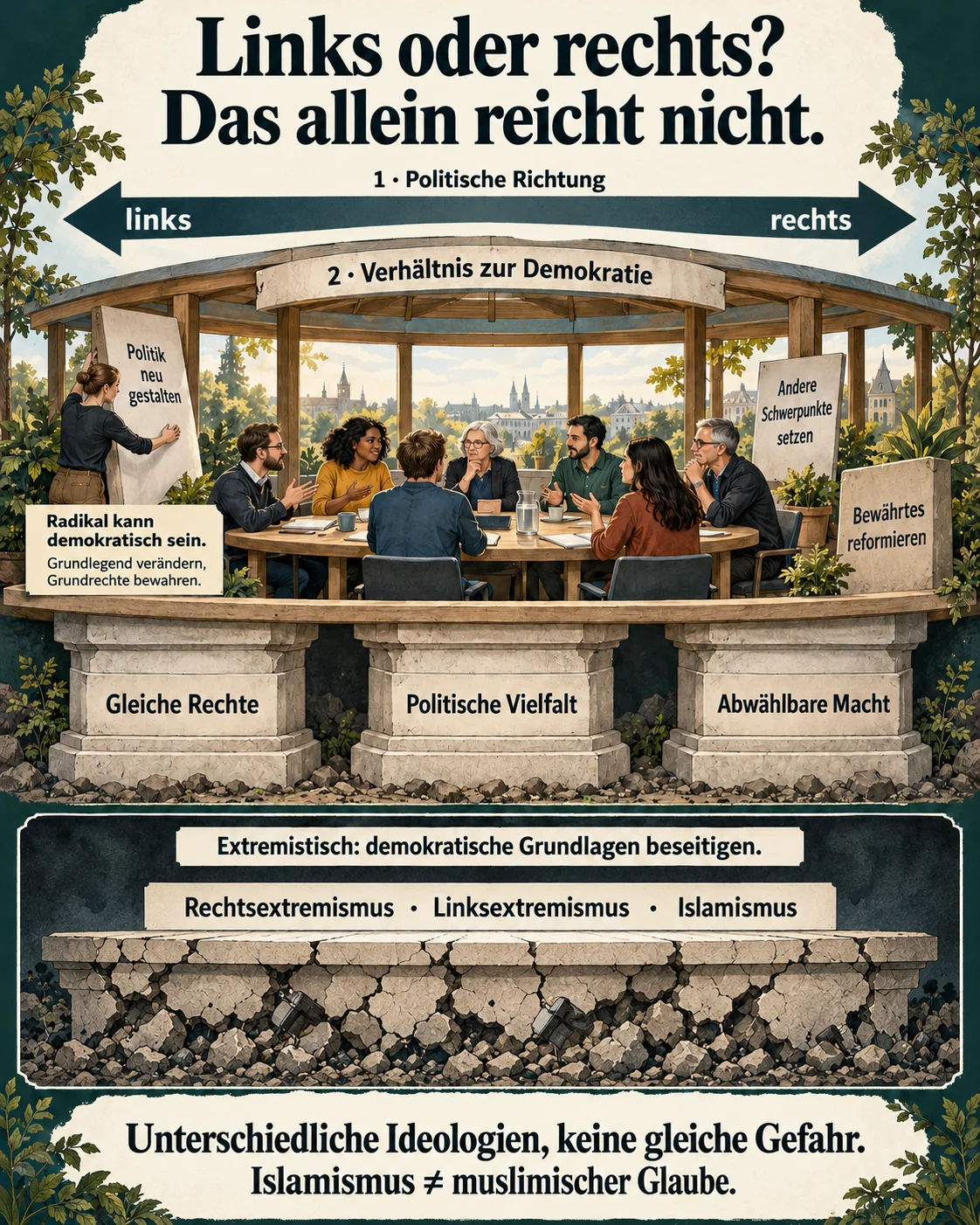
Left and right describe political directions. My standard is equal freedom: being able to disagree and to remove those in power. Demanding fundamental change is democratically legitimate. In the language of German authorities, “radical” does not automatically mean “extremist”; the terms are used in different ways. Explanation of terms, Federal Agency for Civic Education (bpb) (in German).
What the violence figures show
In 2025, German authorities recorded 1,395 right-wing extremist violent offences, compared with 856 left-wing extremist ones and 80 motivated by religious ideology. All three figures rose compared with 2024. The totals do not weight severity: assault, arson, breach of the peace and resisting police officers are different acts. The chart shows the broader category of politically motivated crime (PMK), including non-extremist cases. Federal Ministry of the Interior/Federal Criminal Police Office, tables 9, 10 and 35 (in German).
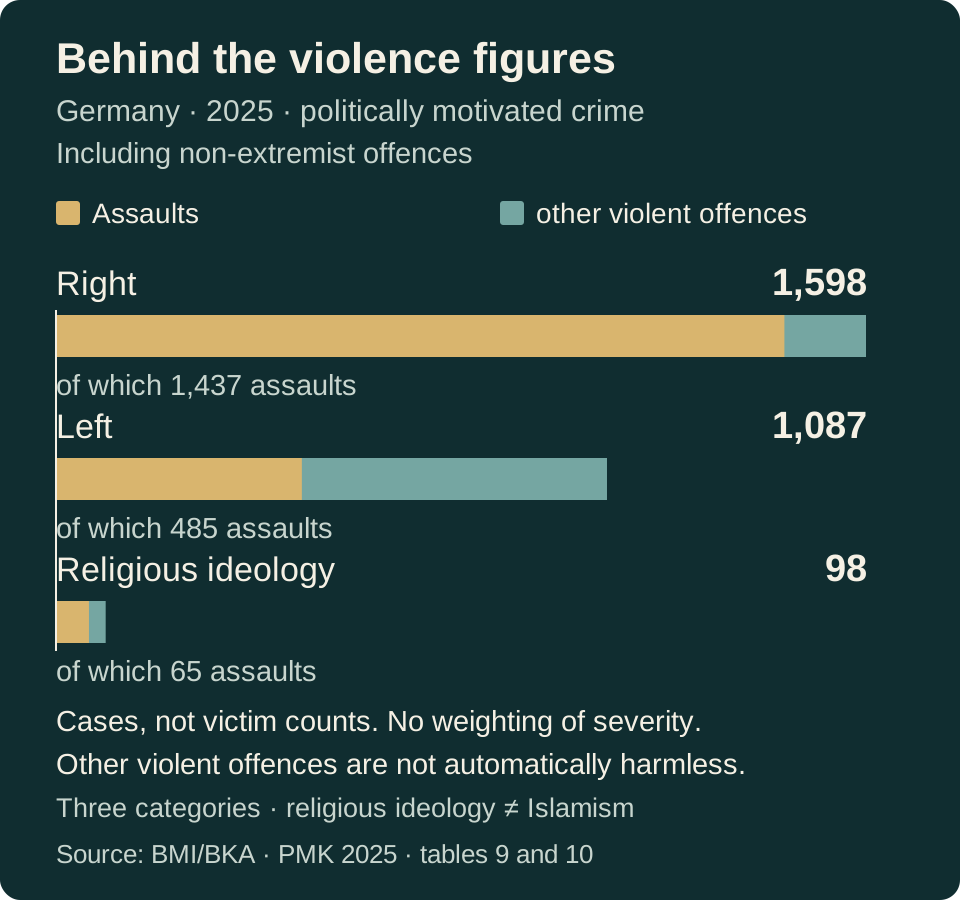
Resisting police officers and serious injuries are not the same thing. Section 113 of the German Criminal Code (in German) requires violence or the threat of violence; mere disobedience is not enough. Throwing stones at people is not excusable protest.
Politically motivated homicide offences in 2025 (PMK): six attempts from the right and one from the left, with no completed offence in either case. For religious ideology, there were eight attempts and two completed offences. Offences are not victim counts; the religious category is not the same as Islamism. A single year is not a historical comparison. Table 11 (in German).
Right-wing extremism: unequal rights
Right-wing extremism is inhumane: it ranks people by origin or by the group they are assumed to belong to. Equal rights become privileges for some groups. The danger grows through violence and through gains in political power. Holding conservative positions or calling for limits on immigration is not extremism in itself.
Naming problems with violence is not racism. Non-Germans are over-represented in violent crime as recorded by the police. But citizenship does not measure culture, and being a suspect is not proof of guilt. A research overview names socialisation in the country of origin, migration and living conditions in Germany as possible influences. Kölbel 2026 (in German).
Researchers asked ninth-graders in Lower Saxony about violence and about their ideas of masculinity. Young people who justified violence as “manly” also reported more often that they had used violence themselves.
The researchers then checked statistically: does the difference in violence between young people with a Turkish migration background and those without one remain if both groups share violence-endorsing ideas to a similar degree? In this comparison, no statistically reliable difference was visible any more.
This suggests that learned ideas should be taken seriously. But it does not prove that they were the cause. The finding cannot simply be transferred to adults or to other groups of origin. Baier/Kudlacek 2019, table 4 (in German).
The fallacy is collective guilt. Justifying violence with “honour” or male superiority deserves criticism, in every milieu. Treating people as dangerous simply because of where they come from, or denying them equal rights, is racist. Calling it “criticism of culture” does not excuse blanket contempt. Conversely, anyone who calls a statement racist must explain where the contempt lies.
The deadly consequences are shown by Halle in 2019, where the antisemitic attacker failed to get through the synagogue door and shot dead two other people, and by Hanau in 2020, where nine people were murdered for racist motives. Background (in German).
The AfD (Alternative for Germany) belongs here because of concrete findings about its ideology: Kai Arzheimer describes a widespread ethnic understanding of nationhood that denies immigrants and their descendants full membership as citizens. I see this as a danger to equal civil rights. According to the bpb, Saxony-Anhalt’s domestic intelligence service lists the party’s state branch there as confirmed right-wing extremist; its provisional result in the 2026 state election is 43.8 percent. The federal party is treated as a suspected case; a court provisionally halted its upgrading to a confirmed case in February 2026. Analysis, classifications and election (both in German).
A vote for the AfD does not prove a closed right-wing extremist worldview. Protest and conviction can be intertwined. But every vote strengthens the party. Criticising this effect does not equate its voters across the board with right-wing extremists or violent offenders. Voters and motives (in German).
Left-wing extremism: justice and coercion
First fallacy: grievances do not prove a better solution. You can criticise poverty and inequality without having a ready-made alternative. But anyone who offers an authoritarian communist order as the better solution must also examine its consequences. Comparing a perfect dream world with our flawed reality proves nothing. How are people provided for? Are they allowed to disagree and vote the government out?
Second fallacy: whoever disagrees is declared unreasonable. In a YouTube discussion, the person I was debating declared the wish to vote socialism out unreasonable and not worth protecting. But who decides what is reasonable? If only the leadership decides, and nobody is allowed to replace it, “reason” mainly protects its power. Your own conviction gives you no right to forbid others to choose.
Third fallacy: successes count, failures are explained away. Successes are supposed to confirm the doctrine. If it fails, it was supposedly always just “betrayal” or “not real socialism”. That way the doctrine can never be wrong. Anyone who promises a better order must say in advance how success and failure can be recognised. Well-founded differences between models matter; simply defining away every bad experience is dogmatic. Disputes within the left, on the other hand, do not in themselves prove intolerance.
Violence is not a theoretical problem: recorded left-wing extremist violent offences rose from 532 to 856 in 2025. The Red Army Faction (RAF) murdered, among others, the employers’ leader Hanns Martin Schleyer and Federal Prosecutor General Siegfried Buback. More recent targeted assaults are described by the domestic intelligence service in connection with the “Antifa Ost” network, to which it attributes attacks with hammers. Declaring opponents “fascists” or “class enemies” does not justify an attack. A just cause does not make violence against people just. PMK, victims of the RAF, official findings (all in German).
The democratic left and the party Die Linke (The Left) must be distinguished from this. In 2018, Thieme described a democratic party as a whole with extremist subgroups; the 2026 account of its organisation names different currents within it. Redistribution or public ownership are not extremism in themselves. What matters is whether free opposition and power that can be corrected are protected. A one-party dictatorship is unfree as a goal already. Assessment, organisation (both in German).
Islamism: faith as rule
Islamist rule places religious precepts above equal freedom. Depriving women, people of other faiths or queer people of their rights is inhumane. Michael Kiefer describes the claim to exclusive truth: one’s own interpretation is meant to answer every question of life, and fundamental norms are not to be open to discussion. That is a political claim to rule. Kiefer, Islamism in Germany (in German).
The fallacy: “My faith is true” becomes “You must live by it”. Islamists invoke the will of God. But that does not explain why their interpretation should also bind people who reject it. Who interprets the rules? Who limits the power of those people? My standard is equal freedom: anyone who wants to live their faith freely must grant the same freedom to people of other faiths and to people who leave their religion.
The Islamist attack on Berlin’s Breitscheidplatz in 2016 shows the deadly danger; Kiefer also describes antisemitic patterns. Religious justification does not make murder and persecution morally better. Assessment and attack (in German).
Not all Islamist groups rely on terror. Some want to reshape state and society according to their religious rules by legal means. Kiefer calls this “legalistic Islamism”. The problem is the goal: if religious precepts are to stand above equal civil rights, peaceful means are no reason for reassurance. Religious people may help shape politics. What matters is whether everyone keeps the same rights. Terms and differences (in German).
The Muslim faith does not imply any shared guilt. Muslims must be free to practise their religion, and also to change or leave it without being punished for it. It is racist to treat people across the board as inferior or dangerous because of their actual or presumed Muslim identity. Racism does not need a biological theory of race. Criticism of specific Islamist demands remains necessary; it must not turn into blanket contempt for Muslims. Criticism and its limits, racialisation (both in German).
What history teaches
The problem also lies in the system: power is shielded from correction. Comparative research on Nazi rule and the rule of the SED, the ruling party of the German Democratic Republic (GDR), examines claims to sole ideological representation, monopolies of power, the judiciary, the public sphere and repression. Thomas Lutz uses the Gestapo and the Stasi to show that both persecuted opponents outside the control of the rule of law. Persecution was a means of securing power. At the same time, the Nazi policy of extermination differs fundamentally from SED repression. Research overview by Manuel Becker, Lutz: structures and differences (both in German).
The Nazis’ consolidation of power in 1933 and the 1953 workers’ uprising in the GDR, crushed by the Soviet military, are concrete expressions of this pattern. Whoever eliminates the opposition and makes those who are supposed to hold power to account dependent protects the leadership from the people. A just order must protect people from the leadership. Social or economic successes do not make such rule free either. What matters is whether dissent is protected and a peaceful change of power remains possible. Nazi Germany 1933, GDR 1953 (both in German).

What right-wing extremism, left-wing extremism and Islamism have in common
My own invented doctrine could also promise to solve every problem and dismiss objections as unreasonable. A promise of salvation is no substitute for reasons, even when we like it.
Groups can provide belonging and reinforce images of the enemy: people then count only as enemies, and violence as a good deed. Practitioners who help people disengage from extremism describe such patterns. Research on hostility towards Muslims and on Islamism examines feelings of threat and group attachment. It does not show that radicalisation is inevitable or that all directions are equally dangerous. Findings from practice (in German), Öztürk/Pickel 2024.
Antisemitism needs a clear response everywhere: against the right-wing extremist violence of Halle, against Islamist conspiracy narratives and against the images of the enemy that Uhlig describes in parts of the anti-imperialist left. Anyone who celebrates terror against Jewish civilians as “liberation” is playing down murder. People on the left also stand up against antisemitism. The party Die Linke, for example, condemns the fact that Israel’s Arab neighbours deny the country the right to exist as a state. Anyone who dismisses specific accusations of antisemitism as a “campaign” still has to respond to the evidence. Uhlig, programme and conflicts (both in German).
Even sharp criticism of Israel’s government is not antisemitism in itself. One warning sign is a rigid picture of perpetrators and victims: Israel is regarded as the perpetrator on principle, and violence against Israeli civilians is excused as “resistance”. Then it is worth asking the counter-question: would I judge the same violence against other people in the same way?
One-sidedness or double standards alone do not yet prove antisemitism. Anyone who focuses on this conflict does not have to address every other conflict as well. One-sided information or rigid thinking in terms of oppressors and oppressed can also narrow one’s view.
A statement becomes antisemitic, for example, when it holds Jewish people collectively responsible for Israel’s policies, denies them equal protection because they are Jewish, or transfers old anti-Jewish images of the enemy onto Israel. Such ideas can also be adopted without conscious intent. Even so, a single statement does not prove a closed antisemitic worldview. Pfahl-Traughber: distinguishing one-sidedness from antisemitism, Cheema: stereotypes and intent (both in German).
Tolerance needs a response
Anyone who demands freedom for themselves and denies it to others is demanding a privilege. This is how tolerance can be turned against its own preconditions. We must contradict authoritarian demands, and prosecute violence and criminal threats consistently.
Freedom of expression also protects anti-democratic views. Bans and surveillance require a legal basis, concrete evidence, proportionality and independent oversight. Opponents of democracy have fundamental rights too. “Protecting democracy” is not a blank cheque. Article 5 of the Basic Law, Mathias Hong on freedom of expression and its limits (both in German).
Shouting “Censorship!” does not refute a measure. But whoever orders it must still justify it: which act, which evidence, which legal power? This standard must apply just the same when our political opponents are in government.
A response also includes prevention that can be evaluated and help for people who want to leave extremist groups.
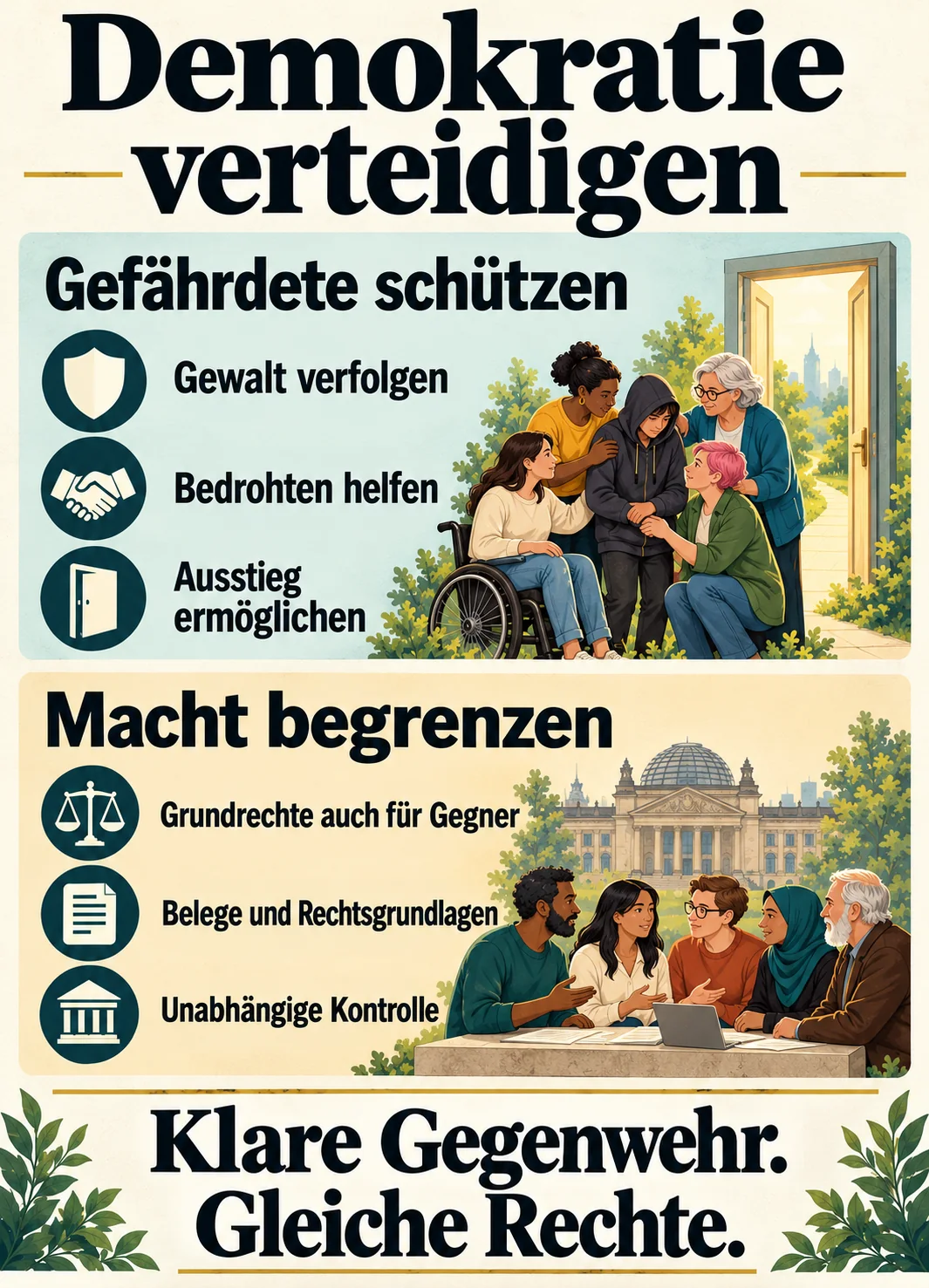
My conclusion: the danger from the right deserves particular attention because of its violence and its political reach. That does not make left-wing extremist violence or Islamist deprivation of rights one bit less harmful. Defending democracy means protecting those at risk, prosecuting violent offenders and defending equal rights, even against majorities. Power must remain limited and open to correction, including our own. Freedom must not become the privilege of the stronger camp.
Written with support from generative AI. Editorial responsibility: Marcus Machon.
Which question will you take with you?
Bring your perspective →