
Opinion
Does anyone really believe we can do this against each other?
An opinion: why thinking, compassion, democracy and cooperation across borders are connected. And why AI is both a test and an opportunity.
This text is an opinion. It contains wishes that sound utopian. Some of them I consider barely achievable myself. I am writing them down anyway, because I believe we need to say them out loud.
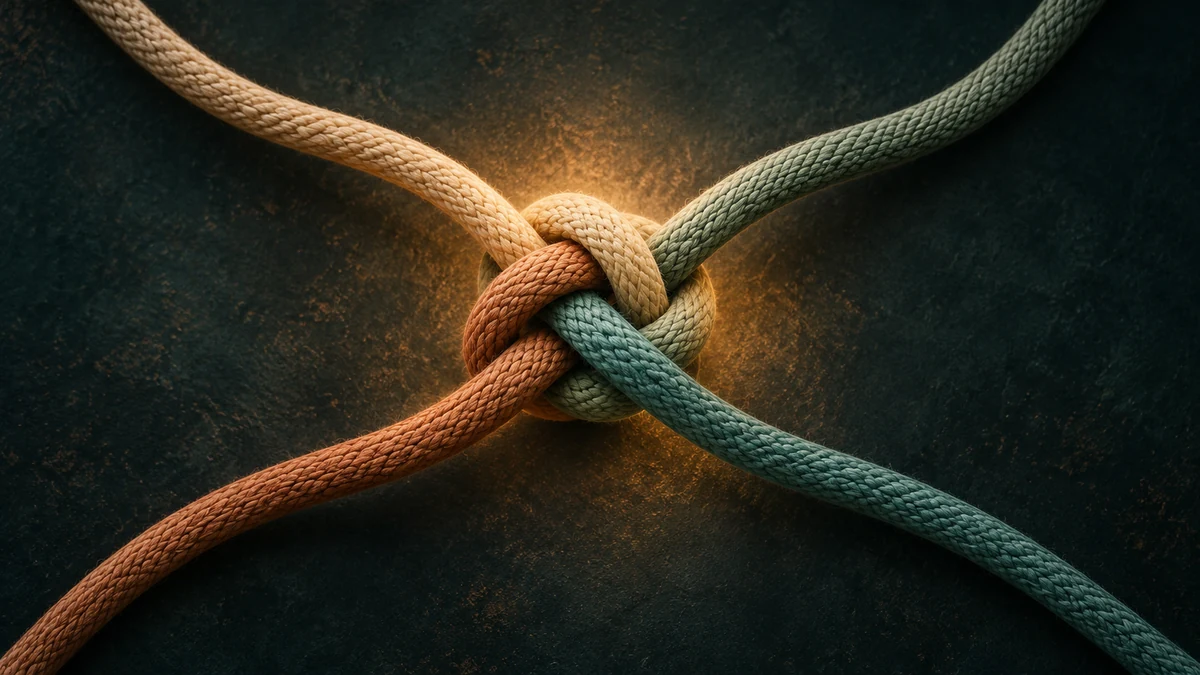
When I look at the problems in our society, I do not see a single mistake. I see a knot. Education, compassion, democracy and the way we treat the world all hang together. Pull on one thread and the others move with it. And right through the middle of this knot runs a new force: artificial intelligence.
Critical thinking can be learned
For me, this knot begins with a question: how well have we learned to check claims before believing or passing them on?
My hypothesis: One important reason for our social problems is that many of us learned too little about critical thinking and evaluating sources at school, and have practised them too rarely since. That means distinguishing evidence from assertions, checking where information comes from and taking counterarguments seriously. Populist messages that offer simple scapegoats and clear enemy images should prompt precisely these questions.
PISA, the international school comparison for 15-year-olds, offers one indication of the current state of education in Germany. The PISA 2025 results, published in September 2026, came as a shock for Germany: in mathematics, reading and science, they are the lowest scores PISA has ever measured in the country. Since 2015, the share of young people who do not even reach the basic level has risen by 17 percentage points in mathematics and by 15 in reading. And how well young people perform at school is more strongly associated with their family’s socio-economic circumstances in Germany than on average across OECD countries – meaning their parents’ education and the resources available to them. OECD: PISA 2025, country note Germany (in German)
The pandemic alone does not explain this; according to the OECD, the decline stretches across the whole past decade. PISA does not directly measure whether someone can think critically, so it does not prove my hypothesis. But the figures show that many young people lack the basics. And without the basics, critical thinking is hard.
With AI, there will hardly be any need to memorise specialist knowledge. We still need the basics. If you know nothing about a subject, you cannot check an answer about it either, not even an answer from an AI. Knowledge is the tool that lets us notice when something is wrong.
This question is already real today: according to PISA, half of 15-year-olds in Germany use AI chatbots for learning at least once a week. In an experiment with almost a thousand school students, those with free access to ChatGPT solved their maths exercises better. In the exam without AI, however, they then did worse than students who never had access. An AI that only gave hints instead of finished solutions largely softened this disadvantage. Bastani et al., 2025 Without guardrails, then, AI can weaken learning.
The crucial question, then, is how we use such tools without outsourcing our own thinking. That includes deliberately practising how to check, challenge and give reasons. There are encouraging findings on teaching critical thinking.
A large analysis of 341 comparisons from experiments in schools and universities found a clear, on average rather small effect, across all subjects and age groups. What helped most were conversations and discussion, real problems instead of artificial exercises, and teachers who guide the process. Abrami et al., 2015
Schools should therefore let students discuss more and practise on real cases. That includes a few simple questions: Who is saying this? How does this person know? What speaks against it? And when should I be especially careful, because a piece of news fits my picture a little too well?
Social media makes this harder. It is not the only cause, but it amplifies what is already in us. An analysis of around 2.7 million posts by US media outlets and members of Congress on Facebook and Twitter found that posts about the political other side were shared about twice as often as posts about one’s own side. Rathje, Van Bavel and van der Linden, 2021 The study shows what the platforms reward. It does not show how this changes opinions. But it fits what I observe: outrage and clear enemy images spread best.
And science? I wish we trusted it more. Not blindly, which would contradict everything science stands for. We should understand how it works: it tests, it argues and it corrects itself. That is why the state of knowledge across many researchers deserves more trust than a single loud voice.
To me, distrusting science across the board while picking out individual studies or experts solely to confirm one’s own worldview does not add up. Evaluating sources means taking findings seriously even when we dislike them. That applies just as much to studies I would like to use to support my own argument.
My view: I see many people relying on a single source and trusting simple answers more than difficult ones. That is exactly why we need an education that makes checking a habit. Because people who cannot check are easier to turn against others. Which brings us to the second thread.
Compassion is not enough if we switch it off
For me, this thread may be the most important one. I sense a lot of anger in our society. Sometimes I can understand it. But I also sense hatred. People are turned into groups, groups into enemies and enemies into objects. And it does not stop with people: how we treat animals and nature also shows how far our compassion reaches.
A large analysis of many studies found only a weak link between general empathy and aggression. Vachon, Lynam and Johnson, 2014 Compassion alone, then, does not reliably stop us from harming others. The psychologist Albert Bandura described what often gets in the way: people soothe their conscience by devaluing others, blaming them or no longer seeing them as full human beings. Bandura, 1999
For me, this means: compassion alone is not enough. We also have to recognise the excuses we use to switch it off. “They brought it on themselves.” “They are not real people.” “With them, it’s different.”
On social media, I occasionally read direct calls for violence against people who think differently or for vigilante action. More often, I encounter statements that justify or suggest such violence: “We are only defending ourselves.” “Someone ought to do something about that.” Sometimes a supposed “right of resistance” is invoked too. Not every statement like this is a call for violence. But I perceive violence against people with different views increasingly being presented as understandable or justified. This is my perception of the posts I read. To me, such justifications show how people can soothe their own conscience while withholding compassion from others.
Research in Germany also gives cause for concern: Beate Küpper and Andreas Zick report increased approval of political violence in the 2022/23 Mitte study. Thirteen per cent of respondents agreed that some politicians deserve it when anger towards them turns into violence. This does not establish how my social media environment or attitudes since then have developed. Küpper and Zick, 2024 (in German)
The right of resistance in Germany’s Basic Law applies when someone seeks to abolish the constitutional order and no other remedy is possible. It is not a general permission to attack people because of their political views. Basic Law, Article 20(4) (in German)
Where do we learn to recognise such justifications and treat others with compassion? First at home. A child needs attention, time and love to experience what it is like to be seen. I believe many parents today are overwhelmed. Often they simply lack time, energy or support. If there is little room for attention and learning at home, school can hardly make up for it. That is why we should support families much more.
Where people devalue each other, deciding together becomes hard too. That leads to the third thread.
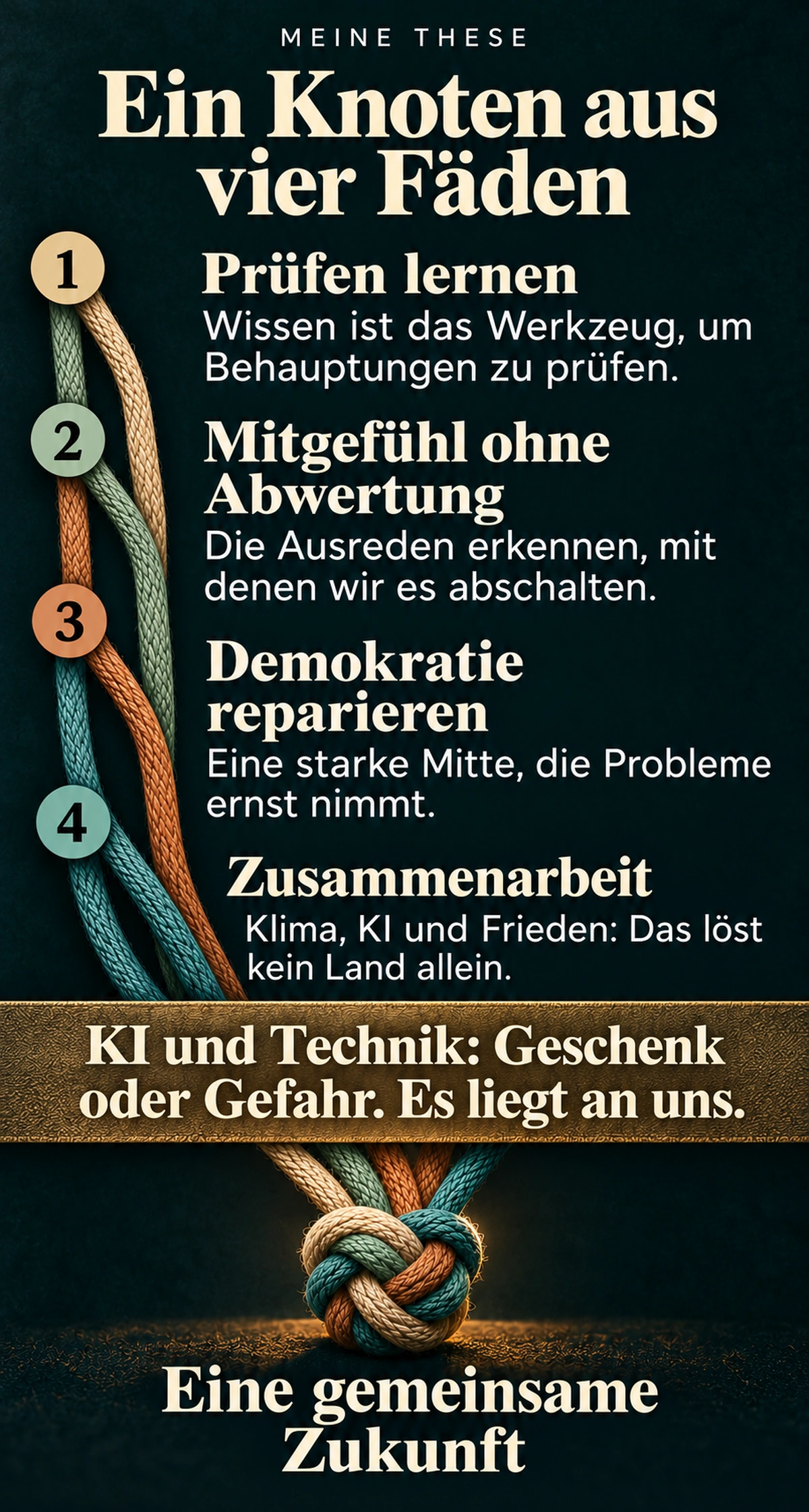
Repairing democracy
I see injustice in our democracy, and I see power gathering in the hands of a few. Even so, I know of no better system. For me, its great advantage is that we can vote governments out without violence and correct mistakes openly. That is why I want to renew it. One problem: we think in electoral terms, but the big crises play out over decades.
Some conclude from injustice and concentrated power that a completely different system is needed, such as authoritarian socialism or communism. My view: I consider this their biggest error in reasoning. Justice convinces me as a goal. A party that nobody can vote out does not convince me as a way to get there. History shows where that has led. In the GDR, people were killed at the border because they wanted to leave the country. bpb: Deaths at the GDR border (in German) In 1968, Warsaw Pact troops ended the attempt to build a freer socialism in Czechoslovakia. bpb: Prague 1968 (in German) Many who call for such a system want a fairer world. But they have to explain what would protect criticism, opposition and a peaceful change of power this time. And anyone who wishes for an authoritarian leader who governs by bypassing parliament is making the same mistake from the right.
What I miss are parties and politics in which large majorities can see themselves again. Not a single unity party; democracy lives from disagreement. But a strong democratic centre that takes problems seriously before extremists exploit them.
Conservative and left-wing positions belong to democracy. It needs both, and the argument between them. But the further someone moves towards the edge, the smaller the step into extremism becomes, often without them noticing. Anyone who sees themselves far to the right or far to the left should watch for this.
My view: Right-wing extremism, left-wing extremism and Islamism are, for me, a shared danger to our democracy. They work with the same means I described above: enemy images, devaluation and, in the end, violence. And they push each other higher.
The figures of Germany’s Federal Criminal Police Office (BKA) for 2025 show how much politically motivated violence we need to take seriously. Around half of all politically motivated offences were right-wing. Right-wing offences also led among violent crimes: 1,598 cases, 7 percent more than the year before. Left-wing violent crimes numbered 1,087, about a third fewer, but 43 percent more than the year before. I take both seriously: the high level of right-wing violence and the rapid rise of left-wing violence. Religiously motivated violent crimes were rarer at 98 cases, but especially deadly: the BKA attributed both completed politically motivated homicides of the year to religious ideology and classified one of them as an Islamist attack. BKA: Politically motivated crime, figures for 2025 (in German) For me, the high number of right-wing motivated offences and violent crimes is an important reason to consider right-wing extremism the greatest threat at present. We must not play down any of the three.
This history also includes murders. The far-right “National Socialist Underground” (NSU) carried out a series of murders. bpb: The NSU and far-right violence (in German) The far-left Red Army Faction (RAF) also murdered people. bpb: The history of the RAF (in German) Neither of these extremist camps can dismiss political violence as solely the other’s problem. This history does not make today’s threats equally great. We need to assess their actual violence and influence separately.
That is why I will be specific. Slogans like “Ausländer raus” (“foreigners out”) or “remigration” also hit people who have long been at home here, and they turn neighbours into enemies. Our constitution, the Basic Law, forbids discriminating against anyone because of their origin or their faith. Basic Law, Article 3 (in German) Openly raising problems with migration and demanding solutions, including deportations in accordance with the law, is part of democracy. Devaluing entire groups does not solve a single problem. And the same applies: anyone who declares police officers enemies across the board, or justifies violence against people who think differently because it supposedly serves a good cause, also turns people into objects. And anyone who wants to put a theocracy above the constitution or declares people of other faiths enemies does the same. Islamism is a political ideology, not the faith of the many Muslims who live here.
A democracy that wears itself down has no strength left for crises that reach beyond its borders. Which brings us to the last thread.
No country can solve this alone
Now it gets big. Perhaps too big. But I believe we have to think this big.
The climate crisis is real. The Intergovernmental Panel on Climate Change calls it “unequivocal” that human influence has warmed the atmosphere, ocean and land. IPCC, 2021
At the same time, AI is changing our world at high speed. For me, it is one of the greatest challenges we face, and perhaps a gift at the same time. It can be misused, for example for surveillance and manipulation. But it can also help us understand diseases and protect the foundations of our lives. That is why, for me, technology and nature are not a contradiction; they belong together. Whether we misuse this gift or use it for good is up to us.
And while all of this is coming towards us, wars are being fought. A war of aggression destroys human lives and resources we urgently need together. Those who are attacked have the right to defend themselves. But no victory protects a country from a crisis that knows no borders.
That is why we need peace and cooperation across borders. Sometimes I think even further, to a kind of world government. I say this openly, but with caution. A power over everyone would need checks that do not exist today. Immanuel Kant already considered a world state dangerous and argued instead for a federation of free states. Perpetual Peace, 1795 Perhaps that is the wiser path: binding common rules, without power becoming uncontrollable.
The questions I ask myself
Does anyone really believe these crises will not come? Or that they will stay small?
Does anyone believe a single country will solve them alone?
Does anyone believe we can solve them without science, compassion, technology and AI?
And does anyone believe we can do it while we despise each other?
I do not. And I believe we do not have much time left.
Every thread of this knot starts small. The next time a post makes you angry, ask briefly: Is it true? Who is saying it? And who benefits from my anger? When you quickly put a person in a box, ask yourself: What do I actually know about this person?
That alone will not change an education system or world politics. But without people who ask like this, neither will change.
Written with support from generative AI. Editorial responsibility: Marcus Machon.
Which question will you take with you?
Bring your perspective →