
Perspective
Does the state only serve the powerful?
Unequal political voice, social protection and failures of the German state: why I defend its welfare and rule-of-law institutions while demanding reform.

In this essay
If you lose your job, an unemployment benefit payment is one tangible way the welfare state can help. Whether politicians listen to you as closely as they listen to your wealthier neighbour is another question. To answer it, it helps to look at decisions both of you should have a say in.
My view of Germany’s welfare and legal institutions is broadly positive. It has to stand up to a serious objection. The state can protect people on low incomes and still give their preferences less weight.
The justified criticism of unequal power
An equal vote does not guarantee an equal political voice. A German study of 252 political survey questions from 1998 to 2013 found that subsequent decisions aligned more closely with the wishes of higher-income groups. The questions were not a random sample of all laws. Even with that limit, the finding remains a serious problem. (Elsässer, Hense and Schäfer 2017, in German)
A systematic review also finds recurring advantages for higher-income groups. Results depend, however, on modelling choices and on how much different groups’ preferences overlap. “Policy more often matches what better-off people want” is therefore better supported. The findings do not determine how much money, lobbying or donations cause this pattern. (Elkjær/Klitgaard, review, online 2021 / journal issue 2024)
Lobbying research offers no simple overall picture either. A German dissertation on tax policy found advantages for large companies over small and medium-sized businesses in how the Bundestag Finance Committee took up demands in the cases examined, after accounting for other factors. An EU study, by contrast, found advantages for citizen groups over business groups on its measure of success. These are different actors and decisions, not a shared success rate or a direct refutation of the income-related finding. (Kraft 2025, in German; Dür, Bernhagen and Marshall 2015, author manuscript)
My conclusion: Political interests receive unequal weight. This does not establish that business interests have disabled democratic decision-making everywhere. That is no all-clear. It is a reason to name specific injustices more accurately.
What the welfare state actually changes
Unequal political voice does not mean that people with little money are left unprotected. Income distribution is one example. The Gini coefficient measures its inequality: 0 means complete equality; 1 means maximum inequality.
For Germany in 2023, the coefficient is 0.497 for market income — such as earnings from work and capital before direct taxes and government cash benefits. For disposable income after direct taxes and cash transfers, it is 0.307. The second value is about 38% lower. That is a substantial difference and a positive finding relative to the goal of a more equal income distribution. It means a lower Gini coefficient, not 38% more income for everyone.
How does Germany compare? After taxes and transfers, its 0.307 was slightly above France’s 0.299 but well below the United States’ 0.394. In this three-country comparison, Germany had slightly more income inequality than France and much less than the US. This is not a ranking of all OECD countries. (OECD Income Distribution Database, same definition and total population, 2023; retrieved 19 October 2026)
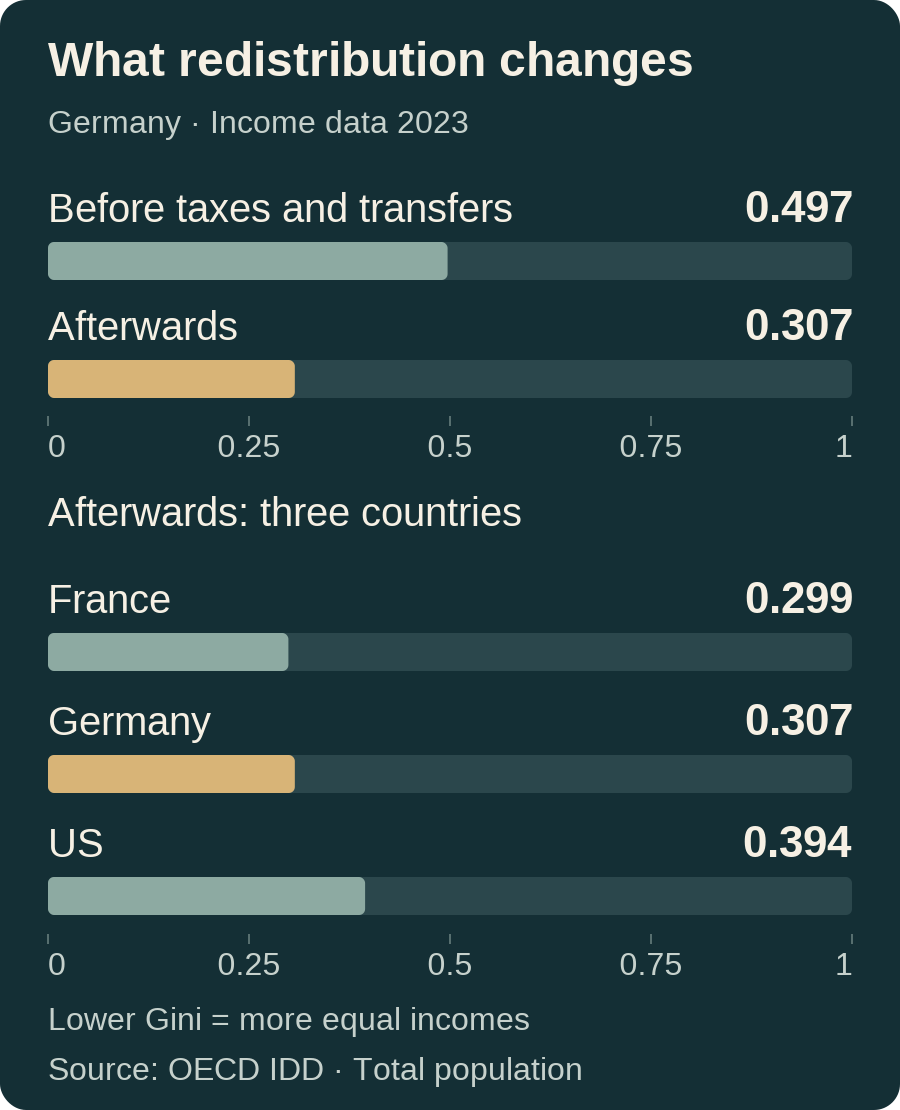
This is not an experiment involving a Germany without a state. Public pensions count as cash transfers here and help shape the difference. Other rules would also change work and saving. The comparison does not capture wealth inequality or the full range of public services in kind. A more equal income distribution proves neither the absence of poverty nor equal political voice.
For the minimum wage, research goes beyond a distributional comparison. The IAB research review from 2019, examining its introduction, reports clear wage gains. The studies also found small employment losses: there were slightly fewer jobs than would have been expected without the introduction, particularly among marginal jobs known in Germany as Minijobs. After the minimum wage was introduced, average working hours in Minijobs fell, limiting gains in monthly earnings relative to hourly pay. For employees covered by social insurance, monthly and hourly earnings rose at similar rates. (Baumann/Bruttel 2020, pp. 4–5, in German) Judged against the aim of raising low wages, that is a positive result with limited downsides. This establishes neither a large employment collapse nor an absence of losses. The finding cannot be transferred to every later increase. (Börschlein/Bossler, IAB Brief Report 24/2019, in German)
Higher pay helps in everyday life. It does not automatically mean that your political preferences count as much as those of wealthier people. Social improvements and unequal influence can coexist. Both belong in the assessment.
Distrust of whom?
My impression was that people across the political spectrum had come to see the state as an enemy. Whether that impression holds up depends partly on which institution someone has in mind. The data distinguish between institutions: in Germany’s 2025 OECD survey, 64% of adults reported high or moderately high trust in the police, 58% in courts and the judicial system, and 35% in the federal government. These figures count answers from 6 to 10 on a scale from 0 to 10. The remainder is not automatically distrust: it includes the neutral answer, 5, and “don’t know”. (OECD, 2026 country note, Figures 1–3)
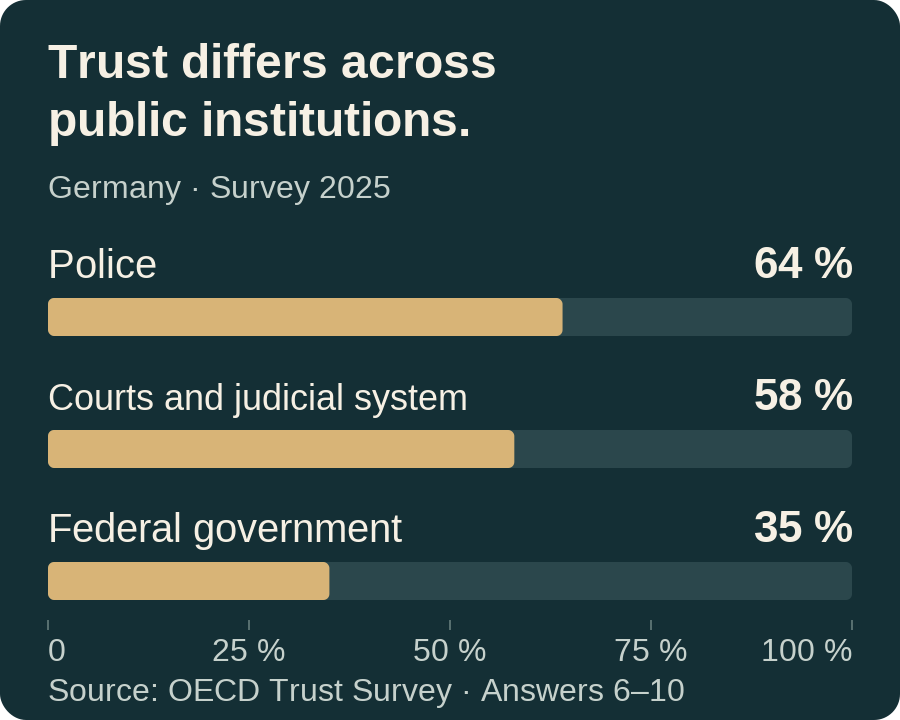
For 2023, the OECD reports the same rounded figures for the police and the judiciary, 64% and 58%, and 36% for the federal government. Two observations establish neither a general collapse of trust nor exact stability. A one-percentage-point difference is not a demonstrated trend without suitable information about uncertainty. (OECD, 2024 country note)
Dissatisfaction extends beyond the political fringes. An analysis of the April 2023 German Longitudinal Election Study found that people placing themselves in the political centre were less often satisfied with democracy than those placing themselves on the left or right, in both eastern and western Germany. Grouping people by party preference, supporters of the German party Alternative für Deutschland (AfD) reported particularly low satisfaction. These are two different groupings and a dated finding. (Mauk/Stroppe, Social Report 2024, p. 357, in German)
This does not measure “contempt for the state”. Someone can distrust a government and rely on independent courts. Someone can be dissatisfied with how democracy works and demand more democracy.
Progress is real. So is the state’s own wrongdoing.
Marriage is now open to same-sex couples in Germany. In 2017, specified criminal convictions for consensual homosexual acts were annulled; the law has a limited scope. These are advances in legal rights. The state was also correcting its own wrongdoing. Earlier persecution remains part of its record, and the reforms do not prove freedom from discrimination in everyday life. (Section 1353 of the German Civil Code; rehabilitation law, Section 1, both in German)
Investigation cannot undo an earlier failure to protect people either. The official 2013 presentation of findings from the first parliamentary inquiry into the NSU, a German far-right terrorist group, describes serious investigative failures, unused leads and failures to connect information. It is a summary, not a comprehensive account of the NSU case. (German Bundestag, 22 August 2013, in German)
The strongest objection to my positive view is this: why should someone defend institutions that repeatedly fail to protect them? People affected owe nobody a favourable overall opinion. High public trust in the police does not refute a discriminatory stop. Acknowledging an error is no substitute for a remedy. My defence of the rule of law must be judged by whether it demands independent investigation, enforceable rights and protection against recurrence — including against public authorities and majorities.
A second standard: protection alone is not enough
Social protection is a right, not a gift from the government. Under Section 27 of Book V of the German Social Code, insured people are entitled to medical treatment when it is necessary. Under Section 137 of Book III, unemployed people are entitled to unemployment benefit if they meet the requirements. Both are subject to conditions and funded through contributions and taxes. These provisions establish entitlements. They do not prove that everyone receives what they are entitled to in practice.
Social provision leaves another question open. What can someone do when the government itself violates their rights? East Germany provided healthcare while denying people a free vote to remove the ruling party.
How Germany’s history tests this standard
Two dictatorships show why protection alone is not enough. Both are associated with crimes, but different ones. The Nazi dictatorship of 1933–1945 was responsible for the systematic mass murder of the Holocaust and waged a planned war of annihilation. (German Federal Archives, Auschwitz; the invasion of the Soviet Union) SED rule in East Germany from 1949 to 1989 provided real social benefits, including healthcare (bpb). But it allowed no free elections through which the government could be removed (German Federal Archives, elections in East Germany). Its practices included surveillance, political imprisonment, psychological torture and Zersetzung, the deliberate disruption of people’s personal and social lives (bpb), as well as violence against people fleeing across the border, including deaths (German Federal Archives, the Stasi and the border).
This does not equate the two regimes or suggest a sequence from Nazi Germany through East Germany to the Federal Republic: both German states were founded in 1949 (German Federal Archives), and the first free election to East Germany’s parliament in 1990 falls outside this comparison. The comparison concerns SED rule, not every socialist idea.
My standard therefore has two parts: does a political order protect people? And can its government be voted out and its actions challenged in court? Germany’s Basic Law provides for free elections in Article 38 and judicial review of state action in Article 19(4). Legal provisions do not guarantee faultless practice, as the section on wrongdoing and failures of protection shows. Social benefits do not justify a dictatorship. An order that promises to provide for me must also answer the question of who limits its power. This is a judgment based on protection, freedom and the ability to correct those in power, not a global ranking of the best states.
What I defend, and what I do not
I defend equal rights, social protection and power that people can effectively challenge. That is precisely why I demand reform wherever people’s interests receive less weight or they are not protected.
Sharp criticism of the government, police or economic system is no proof of extremism. I oppose attacks on equal rights and democratic accountability, whether justified through far-right, far-left or Islamist ideas. The threats are not equal: given the documented violence and political reach of far-right actors, I currently judge right-wing extremism to be the most wide-ranging of these threats. This is my reasoned assessment of risk, not an overall score calculated from violence statistics. (2025 domestic intelligence report, official summary, in German; Federal Agency for Civic Education on the 2026 Saxony-Anhalt election, in German)
The classification as confirmed right-wing extremist cited here concerns the AfD’s state branch in Saxony-Anhalt, not the federal party or individual voters as a whole. Nor do I equate Islamism with Muslims. Applying the same standard requires judging different actions and threats differently.
Better questions for a better political order
Imagine someone applies for a benefit and comes away empty-handed. If the law gives them no entitlement, the rule itself would have to change. If they qualify but the form is almost impossible to navigate, the application needs to be made accessible. And if reform stalls, there is a third question. Whose interests got a hearing when the decision was made? Each explanation points to a different remedy.
Anyone promising a better political order must face the same questions. Add these: who holds its decision-makers accountable? Can its opposition challenge decisions effectively? Those safeguards should remain when your own side governs too.
My position remains: Preserve protection, make political voice more equal, and remedy state wrongdoing. This state deserves criticism, reform and defence. Blanket contempt does not explain its failures any better.
Sources and limits of this assessment
This assessment draws on 26 distinct works and datasets: original analyses, official data, archival sources, laws and research reviews or summaries. It examines domestic social protection and rule-of-law institutions, not Germany’s entire impact on people and nature worldwide. It does not determine how much social division stems from state failures or social media. Nor does it establish that social media inevitably leads people to adopt extremist narratives.
Written with support from generative AI. Editorial responsibility: Marcus Machon.